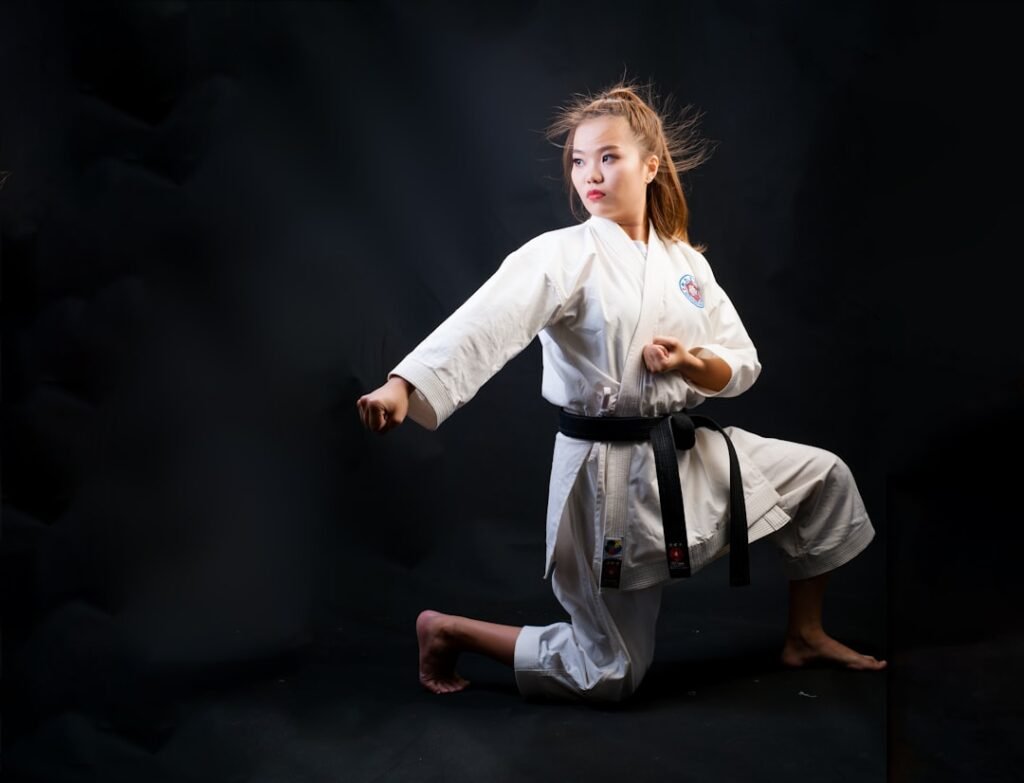
There is a moment every martial arts parent lives for. It does not happen at a big tournament. It does not happen when your child earns a new belt. It happens on an ordinary Tuesday evening when your kid walks into the dojang, bows at the door, and carries themselves like they genuinely belong there. Head up. Shoulders back. No hesitation. That quiet, earned confidence — that is what Tang Soo Do does for children, and it is one of the biggest reasons I have never once regretted putting all four of my boys on the mat.
Confidence is one of those things parents talk about wanting for their kids, but it can feel frustratingly abstract. How do you actually build it? You cannot just tell a child to be more confident. You cannot hand it to them. What you can do is put them in an environment where they face real challenges, work through real struggle, and earn real results — and that is exactly what a quality Tang Soo Do program does, week after week, year after year.
Why Confidence Cannot Be Faked — And Why That Matters
My 10-year-old went through a stretch not long ago where he was struggling socially at school — the kind of low-grade self-doubt that is hard to put your finger on but shows up in a child’s posture, their willingness to speak up, their hesitation before trying something new. I noticed something interesting over the following months: the mat became his reset button. Not because we talked about confidence or gave him pep talks, but because he kept showing up, kept doing the work, and kept getting better at something that is genuinely hard.
That is the secret Tang Soo Do understands deeply. Confidence built through achievement is confidence that sticks. When a child masters a new hyung — a traditional form that requires memorization, precision, and physical coordination — they know they earned it. When they execute a technique correctly after weeks of struggling with it, that feeling of competence is real. It cannot be manufactured by a participation trophy. It has to be lived.
The Belt System as a Confidence Ladder
One of the most powerful structural tools Tang Soo Do offers for building confidence in children is the belt progression system. Each rank has clear requirements. Students know exactly what is expected of them, they work toward it over time, and then they stand before their instructors and demonstrate what they have learned. That cycle — challenge, preparation, performance, achievement — is a masterclass in building self-efficacy.
For my 6-year-old, who is still in the early color belt ranks, the belt system gives him something concrete to work toward. He can see the next step. He knows what it requires. And when he earns it, that sense of accomplishment is written all over his face. For my 15-year-old, who is deep into the advanced ranks, the confidence that has accumulated over years of this process shows up in everything — how he handles pressure, how he leads, how he approaches difficult things in life beyond the dojang.
If you want to understand more about how Tang Soo Do ranks are structured and what each belt level actually means, our guide to Tang Soo Do belt progression breaks it down in a way that makes sense for families just getting started.
Repetition, Failure, and Getting Back Up
Here is what no one tells you when you first walk through the dojo doors: your child is going to fail regularly, and that is completely by design. They will get a technique wrong dozens of times before they get it right. They will lose a sparring round. They will blank on a form during a belt test. And every single one of those moments is doing something important — it is teaching them that failure is not final.
I watched my 12-year-old struggle for weeks with a spinning heel kick that his older brother seemed to pick up effortlessly. The frustration was real. There were a few practices where I could see him wanting to quit on it. But his instructor kept him in it with patient correction, and eventually it clicked. The look on his face when he finally landed it cleanly was worth every difficult session. More importantly, he now has a reference point inside himself — a memory of pushing through something hard — that he can draw on the next time something gets difficult.
This is one of the places where our faith intersects naturally with martial arts training. Perseverance is not just a martial arts value — it is a deeply biblical one. The process of getting knocked down and getting back up, of being refined through difficulty, resonates with how we talk about character in our home. The dojang reinforces those lessons in a physical, tangible way that kids can actually feel.
Public Performance and the Confidence It Requires
One of the most underrated confidence-builders in Tang Soo Do is the regular requirement to perform in front of others. Belt tests, demonstrations, tournaments, and even everyday class participation all ask students to execute what they know under the eyes of instructors, peers, and family. For children who struggle with anxiety or shyness, this gradual, consistent exposure to performance situations can be genuinely transformative.
My 10-year-old, who was quiet and hesitant when he first started, now steps up to demonstrate techniques in class without being asked twice. That did not happen overnight. It happened because the structure of Tang Soo Do gently and consistently required him to show up, speak up, and perform — in a safe environment where the goal is growth, not judgment.
The World Tang Soo Do Association emphasizes character development as a core pillar of the art — not just technical skill. That philosophy shows up in how quality instructors run their programs, prioritizing the whole student and not just the techniques they can execute.
How Parents Can Reinforce Confidence at Home
The work does not stop when your child steps off the mat. What you say and do at home either reinforces or undermines the confidence your child is building in training. Here are some things that have made a real difference in our house:
- Focus on effort, not just outcomes. When your child struggles, affirm the work they are putting in. “I saw how hard you worked on that tonight” lands differently than “You’ll get it eventually.”
- Let them struggle without rescuing them too quickly. It is hard to watch your child frustrated, but the breakthrough that comes from working through it themselves is where the real confidence lives.
- Ask good questions after class. Instead of “How was practice?” try “What was the hardest thing you worked on tonight?” It signals that hard things are worth talking about.
- Show up consistently. Children notice when their training is treated as a priority. Consistent attendance — especially on days when they do not want to go — models the discipline that confidence requires.
- Celebrate the small wins. A technique mastered, a form improved, a moment of good sportsmanship — these are worth acknowledging out loud.
Confidence That Travels Beyond the Dojang
The goal of all of this — the forms, the sparring, the belt tests, the hard days and the breakthrough days — is not to produce impressive martial artists. The goal is to produce confident, grounded young people who carry themselves with integrity in every area of their lives. When my boys walk into a classroom, meet a new adult, handle a conflict with a friend, or face something they have never done before, I want them to have an internal foundation that says: I have done hard things. I can do this too.
That is what Tang Soo Do has given our family, and it is what keeps me driving to the dojang week after week, year after year. If you are a Connecticut family weighing whether martial arts is worth the commitment — whether it will actually make a difference for your child — I want to tell you from the trenches: it does. Not because the art is magic, but because the process of showing up, working hard, and earning your progress is one of the most powerful things a child can experience.
If you are also thinking about how martial arts training can complement the other activities your child is already involved in, this post on how martial arts complements other sports is worth a read. The confidence built on the mat has a way of showing up everywhere else too.
Keep training, keep showing up, and trust the process. The confidence your child is building right now — one class, one technique, one belt at a time — is the real reward.
