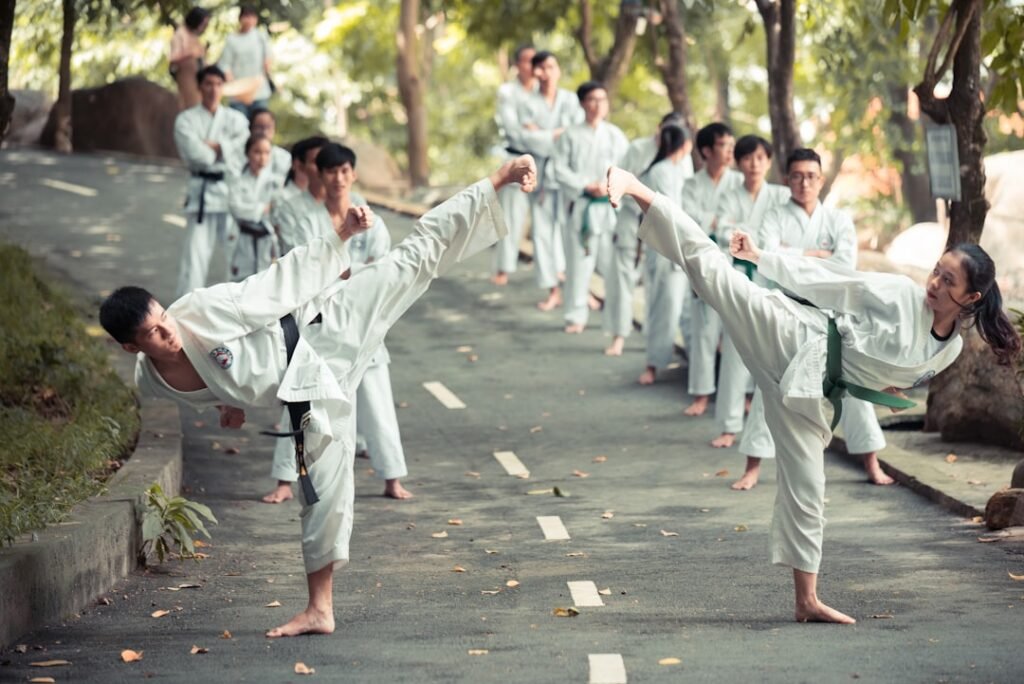
There is a moment every martial arts parent knows. Your child steps off the mat after a sparring match or a forms competition, and they didn’t win. Maybe they placed third. Maybe they didn’t place at all. Their chin drops, their eyes fill up, and everything in you wants to fix it — to say the right thing that makes the sting go away immediately. I’ve lived that moment more than once with four boys in Tang Soo Do. And what I’ve learned over years of training and competing alongside them is this: how a child handles losing is one of the most important skills they will ever develop, and Tang Soo Do is one of the best places on earth to learn it.
We talk a lot about what martial arts builds — confidence, discipline, focus, respect. All of that is true and worth celebrating. But there’s a quieter lesson happening on the mat that doesn’t get nearly enough attention: the steady, patient work of learning to lose with grace. Not just tolerating a loss, but genuinely growing from it. That’s a life skill. And honestly? It’s a character skill. In our house, we’d call it a faith skill too — because learning humility, perseverance, and trust in the process is deeply connected to how we’re called to live.
Why Losing Is Built Into Tang Soo Do Training
Unlike some recreational sports where everyone gets a trophy and scores aren’t always kept, Tang Soo Do doesn’t soften reality. Belt tests have real pass and fail outcomes. Sparring matches have winners. Forms competitions have judges and rankings. That structure is intentional, and it’s one of the reasons I believe so strongly in this art as a tool for raising grounded kids.
From the very first time my 6-year-old stepped on the mat and didn’t nail a technique, or my 15-year-old lost a sparring round to a newer competitor and had to wrestle with his ego about it — the dojang became a classroom for emotional resilience. The difference from other environments is that in Tang Soo Do, failure isn’t the end of the story. It’s the beginning of the next chapter of training.
Our instructors don’t let a bad round or a missed form just sit there. They debrief. They redirect. They ask questions: What did you see? What would you do differently? That coaching approach teaches kids to analyze setbacks rather than just feel crushed by them — and that habit of mind carries into school, friendships, and family life in ways that are genuinely profound.
The Emotional Reality of Losing for Kids at Different Ages
One of the things I’ve noticed training with boys across a wide age range is that losing hits differently depending on where a child is developmentally, and that’s worth understanding before your first tournament or belt test.
For younger kids — my 6-year-old included — losing often registers as immediate sadness or confusion. They may not fully understand the judging criteria or why their friend placed above them. At this stage, the most important response from parents is simple comfort paired with honest, age-appropriate encouragement. Don’t overcorrect. Don’t analyze too deeply. Just be present, validate the feeling, and gently redirect toward what they did well and what they get to work on next.
For kids in the middle range — around the age of my 10 and 12-year-olds — losing can bring out frustration, comparison, and sometimes a desire to quit. This is actually where I’ve seen the most powerful growth happen, because it’s where kids have enough self-awareness to be genuinely embarrassed but not yet mature enough to process it without help. Tang Soo Do training in this stage builds what I like to call constructive stubbornness — the ability to stay in it when it’s hard, not because it feels good, but because they’ve been trained to push through.
For teenagers, losing hits pride. My 15-year-old is at the stage where he genuinely cares about his reputation in the dojang and in competition. A loss for him is a complex emotional event. But I’ve watched Tang Soo Do training teach him something I couldn’t have taught him myself: that how you carry yourself after a loss says more about your character than the win ever would. Bowing respectfully to your opponent, congratulating them sincerely, and walking back to your corner with your head up — those are trained responses. They don’t come naturally. They come from years of practice.
What Parents Can Do to Reinforce These Lessons
The dojang does a tremendous amount of the heavy lifting, but parents are essential partners in this process. Here are some things that have genuinely helped in our family:
- Wait before you talk. After a hard loss, give your child space to feel it. The car ride home doesn’t need to be a debrief. Sometimes it needs to be quiet. Let them process before you process with them.
- Ask questions instead of giving speeches. “What do you think happened?” and “What do you want to work on before next time?” are far more powerful than a long motivational talk from the front seat.
- Separate their identity from their performance. They are not their belt rank. They are not their tournament score. Reinforce this consistently — not just after losses, but all the time.
- Model it yourself. I train in Tang Soo Do too, and my kids have seen me struggle, fail, and keep going. That visibility matters enormously. When they see me handle my own setbacks with faith and persistence, it communicates something no speech ever could.
- Celebrate the effort publicly, address the technique privately. In front of others, honor their effort. In private, have the honest conversation about what to improve. That balance builds both confidence and accountability.
If you’re looking for more on how to support your child through the emotional ups and downs of training, this post on handling setbacks and belt test failures goes deeper into the specific moments that test a martial artist’s resolve — and how families can respond well.
The Tang Soo Do Philosophy Behind Graceful Losing
Tang Soo Do isn’t just a fighting system — it’s a philosophical tradition built on principles that speak directly to how we handle adversity. The concept of Moo Do, or martial virtue, encompasses integrity, perseverance, and self-control. These aren’t decorative words on a dojang wall. They’re meant to be lived, tested, and refined — especially in moments of disappointment.
The World Tang Soo Do Association emphasizes character development as a core pillar of the art — not secondary to technique, but inseparable from it. A practitioner who can execute a perfect Pyung Ahn form but falls apart when they lose hasn’t yet mastered what Tang Soo Do is truly teaching. The mat is the practice ground. Life is the real test.
From a faith perspective, this resonates deeply with me. We are not promised easy paths or guaranteed wins. What we are given is the capacity to persevere, to remain humble, and to trust that growth is happening even when — especially when — it’s invisible to us. Teaching my boys to lose well is, in many ways, teaching them to live well.
When Losing Becomes the Best Training Partner
I want to close with something I’ve seen happen repeatedly in our dojang and in our family: the losses that hurt the most are the ones that produced the most growth. My 12-year-old had a belt test result that genuinely broke his heart. He went back to training the following week with a focus and a hunger that honestly surprised me. The loss became fuel. Not because we made him feel that way — but because the training environment of Tang Soo Do had prepared him to respond that way.
That’s the gift. Not the trophy. Not the rank. The capacity to fall, get up, and go harder — with grace, with humility, and with a heart that stays open to learning. Building real confidence in kids isn’t about protecting them from failure. It’s about equipping them to walk through it.
If you’re raising a child in Tang Soo Do — or considering starting that journey — know that every hard moment on the mat is purposeful. The losses are part of the curriculum. And some of the most important things your child will ever learn, they’ll learn not when they win, but when they don’t.
