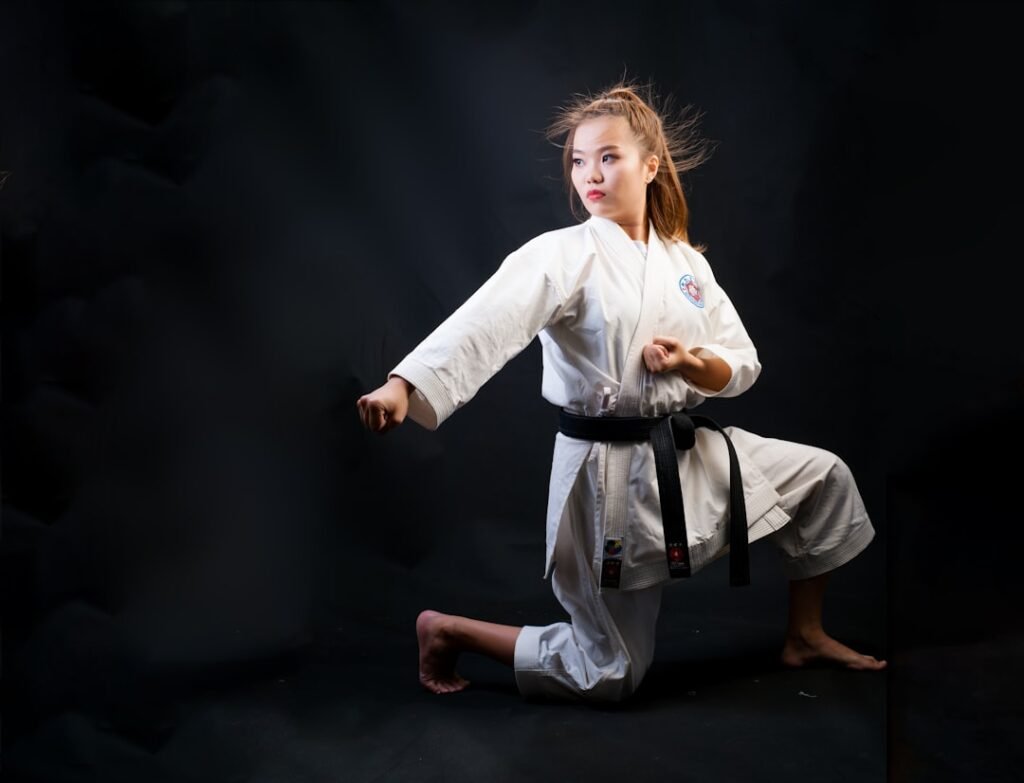
The first time my 10-year-old had to perform his hyung in front of the entire class, he froze for just a second — eyes wide, feet planted — before something clicked and he moved through every technique with quiet determination. After class, he told me he had been so nervous he almost forgot the first move. But he didn’t forget. He had trained it into his body, one repetition at a time. That moment told me everything I needed to know about what forms training is really doing for my boys — and why it deserves a lot more attention than it typically gets from martial arts parents who are newer to the journey.
If you’ve watched a Tang Soo Do class for more than a few minutes, you’ve seen students moving through hyungs — those deliberate, sequential patterns of blocks, strikes, stances, and kicks performed without a partner. From the outside, it can look almost meditative. To a new martial arts parent, it might even seem repetitive in a way that feels unnecessary. But after years of training alongside my four sons and watching what hyungs have built in each of them, I want to make the case that forms training is one of the most powerful tools in the entire Tang Soo Do curriculum — and not just for the reasons you might expect.
What Are Hyungs and Why Do They Exist?
The word hyung (형) simply means “form” in Korean, and in Tang Soo Do, these forms are pre-arranged sequences of techniques designed to simulate combat against multiple imaginary opponents. Each hyung is performed alone, moving through precise directional patterns that correspond to different attack and defense scenarios. The World Tang Soo Do Association recognizes a structured progression of hyungs that students learn as they advance through the belt ranks — beginning with foundational forms like Kee Cho and moving into more complex sequences as rank increases.
Hyungs serve several purposes at once. They preserve the traditional techniques of Tang Soo Do in a format that can be transmitted across generations without requiring a partner or opponent. They teach a student to apply technique with full power, proper form, and correct timing — even without resistance. And they develop the kind of focused, inward attention that is genuinely difficult to build in a child any other way.
The Physical Benefits Are Just the Beginning
Yes, hyungs build strength, flexibility, coordination, and balance. My 6-year-old — who has only been training for a short time — has already developed noticeably better body awareness just from working through the most basic patterns. You can see it in the way he moves, the way he catches himself from a stumble, the way he sets his feet before he kicks. The physical development that comes from repeated forms practice is real and significant.
But here is what I tell parents who ask me about hyungs at tournaments or after class: the physical benefits are almost secondary to what is happening on the inside.
Every hyung demands that a student hold two things in tension at the same time — explosive power and precise control. A technique must be fast enough to be effective but controlled enough to be accurate. A stance must be strong but not rigid. A student must breathe, move, and think simultaneously, and do it all with a kind of calm intentionality that does not come naturally to most children. Training that quality into a kid — session after session, belt after belt — changes something in them.
Memorization, Focus, and the Quiet Discipline of Forms
One thing I have watched hyungs do in all four of my boys is develop genuine memorization skills built on physical practice rather than passive review. My 12-year-old struggles to sit still and study for a spelling test. But he can run through his current hyung from memory, front to back, with full technique, because he learned it with his whole body. That kind of kinesthetic memory is powerful — and it transfers.
Teachers talk about reaching different kinds of learners. Hyungs reach the movers. They teach a child to memorize not just the sequence of steps, but the feel of each transition — the weight shift into a back stance, the hip rotation of a punch, the recoiling of the chamber before a kick. That full-body memorization demands and builds a level of focus that we rarely ask of children in other areas of their lives.
I have also noticed that forms practice teaches my boys how to be alone with their effort. There is no teammate to cover a mistake. There is no opponent to respond to. It is just you and the technique, repeated until it lives in your muscle memory. That experience of being present and accountable to yourself — of not looking around to see how others are doing — is one I want my sons to carry into every area of their lives. It aligns with something I try to teach them from Scripture too: that the work you do when no one is watching still matters. Hyungs make that lesson physical.
How Hyungs Translate to Sparring and Real Technique
New martial arts parents sometimes wonder whether all this forms practice actually makes their child a better fighter or a more capable martial artist in practical terms. The answer is absolutely yes — and experienced Tang Soo Do practitioners see the connection clearly.
When my 15-year-old spars, the techniques he has drilled hundreds of times in hyungs come out naturally, without thought. His back-fist strike is crisp because he has thrown it thousands of times in the context of his forms. His footwork in a combination flows because he has practiced moving through those same patterns in sequence. Hyungs are where technique gets wired into the body. Sparring is where that wired technique gets tested under pressure.
The same applies to self-defense instincts. The blocks and counters that appear in hyungs are not arbitrary — they represent real combat principles. A student who has internalized those patterns through forms training responds differently to physical threat than someone who has not. The body simply knows what to do. That is not an accident. That is what thousands of repetitions build.
What to Expect as Your Child Progresses Through Hyungs
For families who are newer to Tang Soo Do, here is a practical picture of what the hyung journey looks like as your child advances through the ranks:
- White and orange belt levels — Students begin with Kee Cho hyungs, foundational forms that establish basic stance, stepping, and technique. These are short, simple, and foundational. Even my youngest can work through them.
- Green and purple belt levels — Forms become longer and more complex, introducing new stances, combination techniques, and directional changes. The memorization challenge increases significantly at this stage.
- Red belt levels — Students are expected to perform hyungs with increasing power, speed, and precision. The expectation is not just accuracy but expression — the form should look like Tang Soo Do.
- Dan (black belt) levels — Advanced hyungs introduce the most sophisticated techniques in the system. At this level, a practitioner’s forms should reflect years of accumulated understanding, not just memorized steps.
If you want a fuller picture of how belt progression works in Tang Soo Do and what skills are expected at each level, our guide to Tang Soo Do belt ranks and what each one means walks through the full journey from white belt to Dan.
Helping Your Child Fall in Love With Forms Practice
Here is the honest truth: hyungs can feel tedious to a child who does not yet understand what they are building. My 10-year-old went through a phase where he would drag his feet through forms review at home, clearly preferring to drill kicks or gear up for sparring. We had a conversation about it — not a lecture, just a talk — about why the boring repetitions matter. About how the best athletes in any sport do the same drills over and over not because it is exciting, but because excellence lives in what you are willing to practice when it is not fun.
That conversation landed. And I have watched his hyungs improve noticeably as a result of his changed mindset about them.
A few things that have helped our family make forms practice at home feel purposeful rather than like a chore:
- Practicing in front of a mirror so your child can self-correct in real time
- Recording short videos of your child’s hyung and watching them together constructively
- Setting small goals — like performing the form three times without stopping — rather than counting endless repetitions
- Doing forms alongside your child when possible, even if you are learning too
- Connecting to your instructor’s feedback and treating home practice as preparation for the dojang
The strategies we use for keeping our boys motivated through the long journey of martial arts apply here just as much as anywhere else — because the challenge of hyungs is as much mental as it is physical.
The Long Game of Forms Training
There is a reason that a Tang Soo Do master can be identified by watching them perform a single hyung. The form reveals everything — their understanding of the art, their years of practice, the attention they have given to each detail over a lifetime. That depth does not happen by accident. It is the fruit of years of showing up and doing the work, one form at a time.
My sons are not masters yet. But they are building something real every time they step onto the mat and run through their hyungs with intention. They are building bodies that know how to move, minds that know how to focus, and characters that know how to do the hard thing even when it would be easier not to. I cannot think of a better gift to give a child than that — and I am grateful every day that Tang Soo Do puts it within reach for our whole family.
