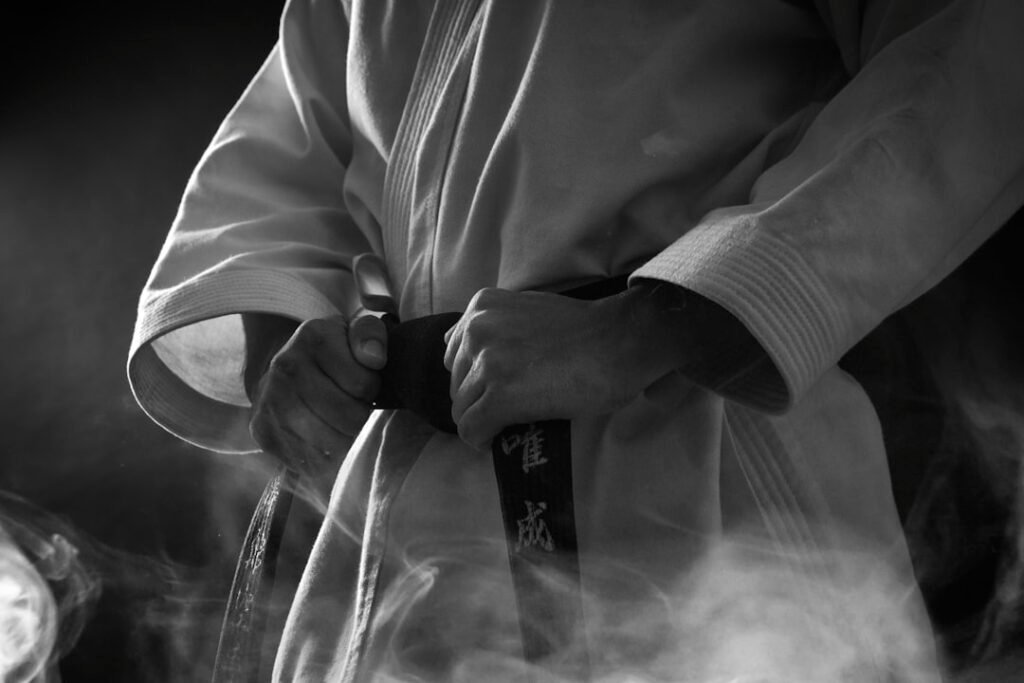
My 10-year-old cried in the car after practice once. Not because he got hurt. Not because another student said something unkind. He cried because he couldn’t get a combination right — and he’d been working on it for weeks. I turned down the radio, let him feel it for a minute, and then said, “That frustration you’re feeling? That’s the lesson. That’s the whole point.” He didn’t totally buy it that night. But three weeks later, when he finally nailed that combination in front of the class, I saw something shift in him. That’s mental toughness. And Tang Soo Do has been building it in my boys one hard practice at a time.
We talk a lot about the physical side of martial arts — the kicks, the forms, the belt tests. But if I’m being honest, the biggest transformation I’ve watched happen on that mat has nothing to do with technique. It has everything to do with what’s happening inside a child’s mind and heart when things get difficult. That internal development is what makes martial arts one of the most powerful tools available to parents who want to raise kids with real, lasting resilience.
What Mental Toughness Actually Looks Like in a Child
Mental toughness isn’t about being emotionless or pushing through pain recklessly. It’s the ability to stay focused when it’s hard, to keep trying when progress feels invisible, and to regulate your emotions when frustration peaks. In kids, it shows up in subtle but meaningful ways — the child who gets corrected and tries again instead of shutting down, the one who doesn’t quit when a drill feels impossible, the one who steps up when they’d rather step back.
My 15-year-old has been training long enough now that I can see it clearly in how he carries himself outside the dojang. He handles pressure differently than he did years ago. He’s slower to react, more willing to stay in uncomfortable situations until they resolve. That didn’t happen by accident — it happened because Tang Soo Do has repeatedly put him in situations where quitting was the easier choice and taught him, over and over, to choose differently.
My 6-year-old is just beginning that journey, and already I can see the seeds being planted. When he wants to give up on a new stance and his instructor calmly redirects him back to try again, something is being built in that small moment that will compound over time.
The Structure of Tang Soo Do Creates Mental Discipline
One of the reasons Tang Soo Do is particularly effective at building mental toughness is because of its structure. Every class follows a pattern of discipline — bowing in, warming up, drilling, practicing forms (hyungs), and bowing out. That structure is not accidental. It mirrors the kind of disciplined routine that high-performing people in every field rely on.
When kids train within that structure repeatedly, they internalize it. They learn that results come from showing up consistently and working within a framework — not from doing whatever feels good in the moment. Proverbs 25:28 says, “Like a city whose walls are broken through is a person who lacks self-control.” That verse hits different when you’re watching your kids practice self-regulation on the mat in real time.
Hyungs — the formal patterns of movement practiced in Tang Soo Do — are a perfect example of how this mental discipline develops. A hyung requires a student to memorize a specific sequence, execute it with precision, and perform it under pressure. There are no shortcuts. You either know it or you don’t. That process of learning, failing, adjusting, and eventually mastering a form is a complete mental toughness training cycle on its own.
How Instructors Shape Resilience Without Breaking Spirit
A good Tang Soo Do instructor understands something that takes parents a while to learn — the goal isn’t to eliminate struggle, it’s to teach kids how to be in it productively. The correction culture in our dojang is one of the things I value most. When my 12-year-old gets corrected, the instructor doesn’t soften it to the point of meaninglessness, but they also don’t deliver it in a way that humiliates. It lands clearly, and then there’s an expectation to apply it.
That kind of correction — firm, respectful, and followed by immediate opportunity to improve — is a masterclass in how to build resilience. Kids learn that being corrected is not a judgment of their worth. It’s information. That reframe is enormous for children who struggle with perfectionism or who tie their identity to performance.
The World Tang Soo Do Association emphasizes character development as a core pillar of the art — not just as a nice bonus, but as central to what Tang Soo Do is. That philosophy shows up in how quality instructors approach their students, especially young ones.
The Role of Belt Testing in Building a Tough Mindset
Belt tests deserve their own conversation when it comes to mental toughness. There is nothing quite like watching your child stand in front of an instructor and panel, perform under pressure, and wait for a result they can’t control. It’s genuinely stressful — for them and for the parent sitting in the back trying not to visibly hold their breath.
But that pressure is the point. Belt tests teach children how to prepare, how to manage nerves, and how to perform when the stakes feel high. Whether they pass or need to test again, there is growth in the experience. The child who passes learns that hard work pays off. The child who doesn’t pass learns something arguably more valuable — that a setback is not the end of the story. How families handle those setback moments matters enormously for whether the lesson sticks or whether the child walks away feeling defeated.
My boys have had both outcomes. And I’ll tell you honestly — some of the most meaningful growth I’ve seen came after the harder results.
Mental Toughness Transfers Beyond the Dojang
This is what I want Connecticut families considering martial arts to really hear: the toughness your child builds on the mat doesn’t stay on the mat. It travels with them into the classroom, onto the soccer field, into friendships, and eventually into adulthood.
When my 12-year-old faces a difficult assignment at school, I’ve noticed he approaches it differently than he used to. He sits with the difficulty longer before asking for help. He’s more willing to try something wrong before refining it. That is a martial arts habit. He learned it in the dojang, and now it lives in him everywhere he goes.
Research consistently supports this. Studies on youth martial arts participation show improved self-regulation, reduced anxiety, and stronger academic focus in children who train regularly. The Amateur Athletic Union has long recognized martial arts as one of the most comprehensive disciplines for developing whole-child athletic and character development.
- Focus under pressure — belt tests, sparring, and performance drills train kids to stay present when anxiety spikes
- Delayed gratification — the long journey from white belt to black belt teaches children to work toward goals that take years, not days
- Emotional regulation — learning to manage frustration during a difficult drill carries directly into managing frustration in everyday life
- Persistence — the repetitive nature of technique training builds a habit of not quitting before mastery is reached
- Confidence under challenge — each obstacle cleared in the dojang deposits confidence that says “I’ve done hard things before, I can do this too”
What You Can Do at Home to Reinforce It
The dojang does tremendous work, but parents are partners in this process. A few things I’ve found genuinely helpful in reinforcing mental toughness at home between practices:
Resist the urge to rescue too quickly. When your child is frustrated with a technique, give them space to sit in that frustration before jumping in. Your instinct to help is good — but learning to tolerate discomfort is part of the curriculum.
Talk about effort, not just outcome. After a class or a test, ask what they worked hardest on — not just whether they did well. This trains their internal metric toward effort rather than performance.
Connect their dojang growth to other areas of life. When you see mental toughness showing up at school or in another activity, name it. “That’s the same thing you do when a hyung is hard — you keep going.” Make the connection explicit so they own it.
If you’re exploring what to look for in a quality martial arts school in Connecticut, pay attention to how instructors handle struggle in the classroom. A school that builds mental toughness well will have a culture where hard things are expected, mistakes are corrected with respect, and every student is consistently encouraged to try again.
The kicks and forms matter. The belts matter. But what we are really building in this art is something that will serve our children for the rest of their lives — a mind that doesn’t fold when things get hard. That’s worth every early morning practice, every frustrating plateau, and every teary car ride home. The mat is doing its work. Trust the process.
