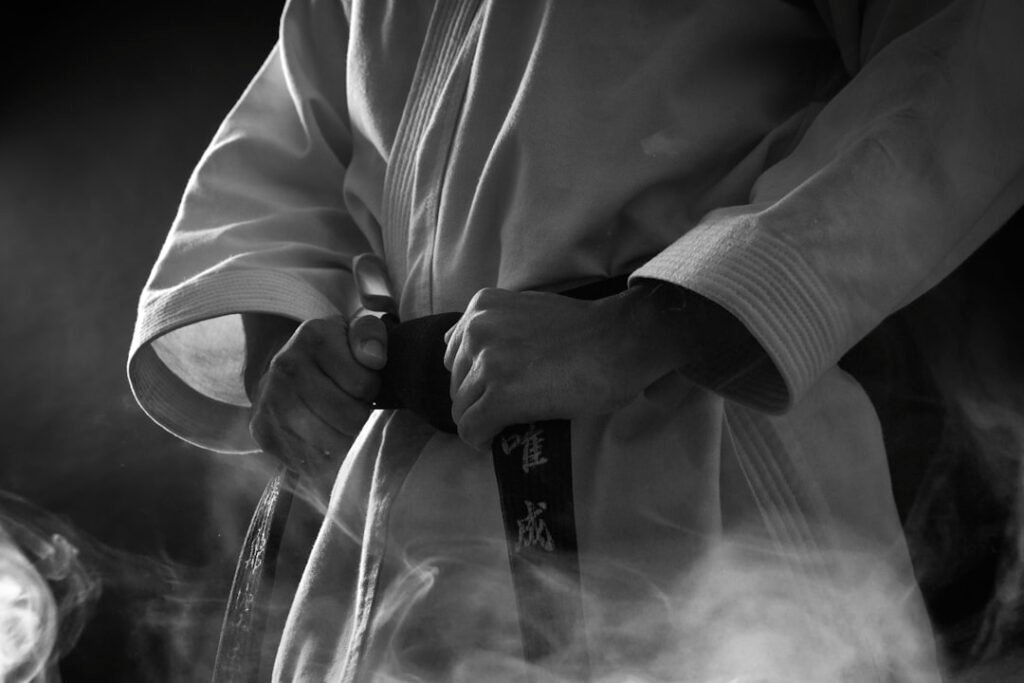
There’s a moment that every martial arts parent knows well. Your child is standing in front of the class, about to demonstrate a form they’ve been drilling for weeks. The room is quiet. Every eye is on them. And you can see it happening in real time — the shoulders tighten, the breath gets shallow, the fingers fidget at their sides. Pressure. Pure, undiluted pressure.
I’ve watched each of my four boys go through that exact moment, and I’ll be honest — the first few times, it was hard to watch. My 6-year-old once froze completely in the middle of a basic form he could do in his sleep at home. My 15-year-old, who now carries himself with a quiet confidence that genuinely takes my breath away, used to turn bright red the moment he felt like people were watching him. The mat has a way of putting your child’s inner world on full display.
But here’s what I’ve come to understand after years of training alongside my boys: that pressure is not the enemy. It is the curriculum. Tang Soo Do doesn’t just teach kicks and blocks — it teaches children how to stand steady when everything inside them wants to bolt. And the skills they build on the mat follow them into classrooms, onto athletic fields, into friendships, and eventually into every corner of their adult lives.
Why Kids Struggle With Pressure in the First Place
Before we talk about what martial arts does, it helps to understand why pressure hits kids so hard. Children’s brains are still developing the prefrontal cortex — the part responsible for regulating emotion, making decisions under stress, and managing fear responses. When a child feels watched, evaluated, or challenged, their nervous system can fire off a genuine threat response. It’s not drama. It’s biology.
For many kids, the environments where they experience pressure — school tests, sports tryouts, recitals — don’t offer many tools for processing it. They perform, they succeed or fail, and they move on. There’s rarely a structured, repetitive practice for learning to stay calm under fire. That’s exactly the gap that martial arts fills.
The Dojo as a Pressure Training Ground
What makes the dojang — our training hall — so uniquely effective is that pressure is built into the format by design. From the very first class, students are asked to perform in front of others. They bow in, they recite the student creed, they demonstrate techniques while the instructor watches. There is nowhere to hide, and that’s intentional.
Over time, that repeated exposure does something remarkable. The nervous system begins to recognize that pressure is survivable. The moment that once felt catastrophic starts to feel manageable. Then familiar. Then — and this is the part that always moves me — it starts to feel like fuel.
My 12-year-old had a breakthrough moment during a recent sparring session. He had been struggling with getting flustered whenever he faced an opponent who moved fast and unpredictably. We talked about it after class, and he said something I’ll never forget: “I figured out I have to breathe first and think second.” That is not a small insight for a 12-year-old. That is emotional regulation. That is the kind of wisdom adults pay therapists to help them find.
Specific Ways Tang Soo Do Builds Pressure Tolerance
It’s worth getting concrete here, because “martial arts builds confidence” can start to sound like a slogan if we’re not careful. Here’s what’s actually happening in class that trains children to handle pressure:
- Forms practice (hyungs): Performing a memorized sequence of techniques — alone, in front of a group, with no partner to lean on — is a direct simulation of high-stakes individual performance. Every test, every class demonstration, every tournament form builds that solo mental endurance.
- Belt testing: The belt test is a structured, high-pressure evaluation where students must demonstrate everything they know. The anticipation, the preparation, and the performance itself all train the child to move through anxiety rather than around it.
- Sparring: Free sparring requires real-time decision-making under physical and mental pressure. A child cannot think their way through it — they must react, adapt, and recover from mistakes immediately. This is extraordinarily good training for real life.
- Rank-based responsibility: As students advance, they are increasingly expected to demonstrate techniques for newer students or lead warm-ups. With rank comes visibility, and with visibility comes healthy pressure.
- Competition: For families who choose to pursue it, tournaments bring all of these elements together in a single high-stakes environment. The Amateur Athletic Union hosts martial arts events where children can compete at regional and national levels — and just showing up to that environment is growth, regardless of the outcome.
The Mental Framework Tang Soo Do Teaches
One of the things I appreciate most about Tang Soo Do — and about our school specifically — is that instructors don’t just put kids in pressure situations and walk away. They actively teach a mental framework for navigating those moments. Students learn that mistakes are part of training, not evidence of failure. They learn to reset quickly and keep moving. They learn that how you respond to a stumble matters more than the stumble itself.
As a person of faith, I find deep resonance in this. Scripture is full of reminders that our character is forged in difficulty — that endurance, refinement, and growth happen through the hard moments, not in spite of them. Watching my boys internalize that truth on the mat — without me having to lecture them about it — is one of the most gratifying parts of this journey. The dojang becomes a place where values are caught, not just taught.
If you’re exploring what to look for in a school that takes character development seriously, our post on what to look for in a quality martial arts school in Connecticut walks through the questions every family should be asking before they commit.
What Parents Can Do to Reinforce This at Home
The work doesn’t stop when you leave the dojang. There are real, practical things you can do as a parent to reinforce the pressure-management skills your child is developing in class:
- Resist the urge to rescue too quickly. When your child is frustrated or overwhelmed, pause before jumping in. Give them a moment to try to regulate themselves first. You’ll be surprised how often they can.
- Talk about the process, not just the outcome. After a hard class or a tough sparring session, ask how they felt and what they tried — not just whether it went well. This reinforces that effort and learning matter more than performance.
- Model it yourself. I train alongside my boys, and they watch how I handle my own hard moments on the mat. When I mess up a form in class or struggle in sparring, I try to reset with grace. Children notice everything.
- Celebrate the brave moments, not just the successful ones. Getting back on the mat after a bad test, trying again after a stumble, showing up when you’re nervous — these are the victories worth celebrating loudly.
The Long Game: Why This Matters Beyond the Dojo
My 10-year-old recently had a school presentation that he was incredibly anxious about. He came home afterward and told me it went fine — that he’d gotten nervous but remembered to breathe and focus on one thing at a time. He didn’t connect it to martial arts explicitly. He didn’t need to. The skill had transferred.
That is the whole point. We’re not just raising kids who can perform a good back kick. We’re raising young people who know how to stand in a hard moment and not fall apart. Who can feel the pressure and move anyway. The World Tang Soo Do Association describes the art as a vehicle for developing the whole person — mind, body, and spirit — and after years on this journey, I believe that completely.
The mat is going to ask hard things of your child. It’s going to put them in front of people when they’re uncertain. It’s going to ask them to try things they’ll get wrong before they get right. And every single one of those moments — every sweaty palm, every flushed face, every deep breath before a form — is building something in them that no classroom, no lecture, and no pep talk can replicate.
That’s not pressure. That’s preparation. And it might be one of the most important gifts you ever give them.
