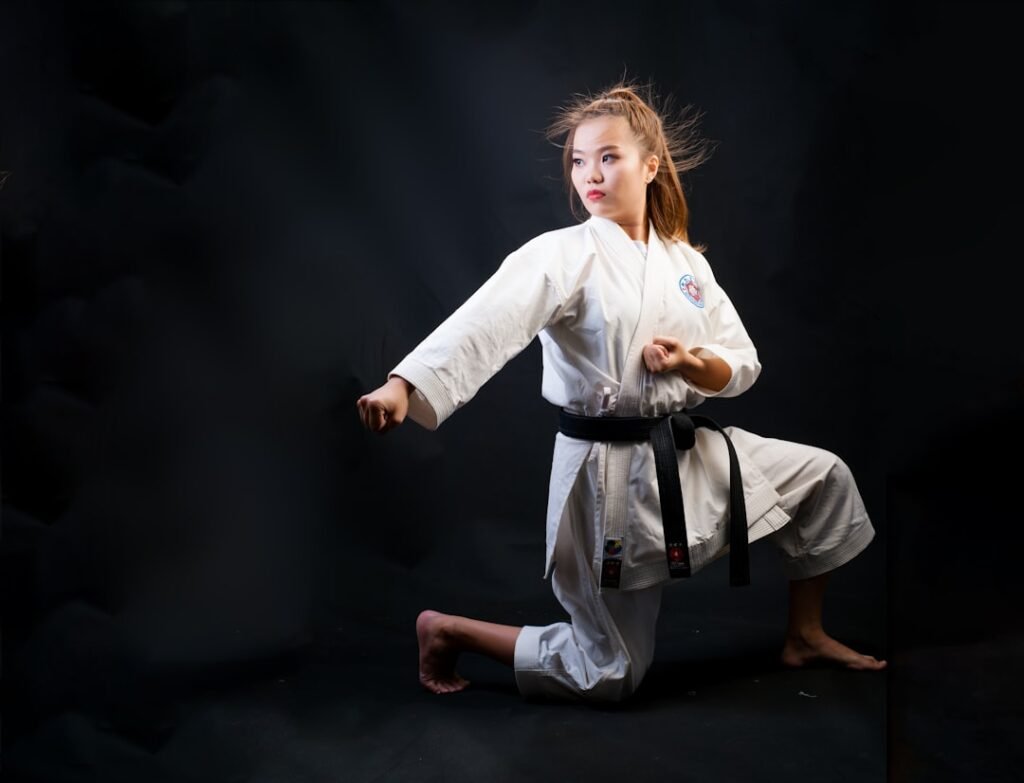
The first time I watched my 10-year-old run through a hyung on his own — no instructor counting, no classmates beside him — something shifted in me. He wasn’t just moving through techniques. He was thinking. Planning. Correcting himself mid-sequence. He looked, honestly, like a completely different kid than the one who used to melt down over homework. That moment made me understand something about Tang Soo Do forms that no one had fully explained to me before: hyungs aren’t just memorized patterns. They are one of the most powerful mental and character-development tools in all of martial arts.
If you’re a Connecticut family with a child in Tang Soo Do — or thinking about enrolling — and you’ve watched students move through these structured sequences and wondered what the point is beyond looking impressive, this post is for you. Let’s dig into what hyungs actually are, why they matter so much in Tang Soo Do training, and what your child is genuinely building every single time they practice one.
What Is a Hyung in Tang Soo Do?
The word hyung (형) is the Korean term for “form” — a prearranged sequence of offensive and defensive techniques performed solo against imaginary opponents. In Tang Soo Do, hyungs are a foundational component of training at every rank level. You’ll sometimes hear them called poomse in other Korean arts or kata in Japanese styles, but in traditional Tang Soo Do, the term is hyung.
Each hyung follows a specific pattern on the floor, incorporates particular stances, strikes, blocks, and kicks, and is performed with a set rhythm and energy. They range from relatively simple forms practiced by white belts to highly complex, demanding sequences that senior color belts and black belts spend years refining. The World Tang Soo Do Association recognizes a structured curriculum of forms that progress alongside rank — each one building on the physical and mental skills developed in the last.
Our school follows this progression faithfully, and watching my boys move through their respective hyungs — from my 6-year-old’s early basics to my 15-year-old’s advanced forms — I can see the whole arc of development laid out in front of me. It’s a beautiful thing.
More Than Memorization: The Mental Work Behind Forms
Here’s what I want parents to understand who might see hyung practice as repetitive or old-fashioned: practicing a form is one of the most cognitively demanding things we ask children to do in a dojo.
To perform a hyung correctly, your child must simultaneously manage:
- The correct sequence of movements — in the right order, every time
- Proper body mechanics — stances, chamber positions, hip rotation, and follow-through
- Spatial awareness — knowing where they are on the floor and where they’re headed next
- Timing and rhythm — not rushing, not dragging, finding the controlled pace
- Breath control — coordinating exhales with power strikes and maintaining composure throughout
- Focus — blocking out the room, the noise, the nerves, and just moving
That is a remarkable amount of mental multitasking for a child of any age. And unlike a video game or a sport where feedback is immediate and external, the feedback in a hyung comes largely from within. Your child has to self-assess. Self-correct. That internal regulation is genuinely rare, and it translates powerfully into academic focus, emotional management, and personal responsibility.
What Each Stage of Hyung Practice Teaches
The learning isn’t static — it evolves as the child grows and their training deepens. Here’s how I’ve seen it unfold with my own boys:
Early ranks: At this stage, the hyung is about learning to follow a sequence, build basic body awareness, and develop the habit of practice. My 6-year-old is learning to channel his boundless energy into intentional movement. The form gives him a container for that energy. He learns that some things require patience and repetition — and that’s okay.
Mid-level color belts: The hyungs become more complex, and students begin to understand that knowing the steps isn’t the same as performing them well. This is where discipline really kicks in. My 10-year-old reached a point where he knew his form but it wasn’t sharp. His instructor helped him understand the difference between “doing it” and “doing it right.” That lesson — that competence has layers — is one he carries into everything now.
Advanced color belts and approaching black belt: Here, students are expected to perform their hyungs with power, precision, and presence. They start to understand the martial application behind each movement — what the blocks are actually blocking, what the sequences mean in a self-defense context. My 15-year-old is at this stage, and watching his forms now compared to two years ago is extraordinary. The movements carry intention.
Hyungs and the Character Lessons They Carry
There’s a reason Tang Soo Do forms have been passed down for generations. They aren’t just effective training tools — they carry within them a philosophy of how to approach challenge, difficulty, and growth.
Every time a student steps into their starting position and bows before beginning a hyung, they are practicing humility and intentionality. Every correction from an instructor that requires them to go back and do it again — a hundred times if necessary — is building perseverance. Every tournament performance where they must stand alone on a floor and deliver their form under pressure is building courage.
As a mom of faith, I see these lessons as deeply aligned with how I want to raise my boys. Proverbs 22:6 says to train up a child in the way he should go. For our family, part of that training happens in the dojo, in the quiet discipline of repeating a form until it becomes second nature — until the right response is the instinctive one. There is something sacred about that kind of formation.
If you’re curious about how the broader values of Tang Soo Do connect with faith and character, I wrote more about that in my post on how Tang Soo Do’s core values align with raising faith-centered kids.
Forms as Preparation for Real Pressure
One thing that sometimes surprises parents is that hyungs are a major component of Tang Soo Do tournaments. Students compete individually, performing their forms in front of judges who score on technique, power, focus, and presentation. That means the same child who practiced in the dojo now has to deliver that same form — alone — while being watched and evaluated.
This is, in my experience, one of the most confidence-building experiences a child can have in martial arts. Not because winning feels great (it does), but because standing in front of a room and performing something you’ve worked hard on — and doing it well — teaches a child what they’re capable of.
My 12-year-old struggled badly with nerves before his first tournament forms performance. He wanted to back out. We talked about it, prayed about it, and he went out there anyway. His form wasn’t perfect, but he finished it with his head up. He came off the floor different than he walked onto it. That’s what hyungs do when the pressure is real.
For more on navigating competition nerves, you might find helpful thoughts in my post about helping kids manage tournament nerves in martial arts.
How to Support Your Child’s Hyung Practice at Home
You don’t have to be a black belt to help your child improve their forms at home. Here are simple, genuinely useful things parents can do:
- Give them space and time. Even 10 minutes a few times a week makes a real difference. A cleared living room floor works perfectly.
- Ask them to teach you. When a child explains and demonstrates a sequence to a parent, they reinforce their own understanding deeply. My boys love “teaching” me their forms — and I learn a lot in the process.
- Watch without critiquing. Your job isn’t to correct technique at home — that’s the instructor’s role. Just being an attentive, encouraging audience matters more than you know.
- Celebrate the effort, not just the outcome. “I noticed how focused you were” means more than “that looked great.” Process-focused praise builds intrinsic motivation.
- Practice yours alongside theirs. If you train too, work your own form while they work theirs. There is something powerful about a family practicing in the same space together.
The Long Game
Hyungs are not learned once and set aside. They are returned to again and again — refined, deepened, made more powerful as the student grows. A form my 15-year-old learned at white belt looks nothing like it did then, because he is nothing like he was then. That’s the point. The form is a mirror.
If your child is in Tang Soo Do and has been resistant to form practice, I want to encourage you: stay with it. The payoff is not always visible in the short term, but it accumulates quietly in their focus, their composure, their confidence, and their character. This is long-game parenting. And it is absolutely worth it.
The dojo teaches what the classroom and the playing field sometimes can’t — that some things only come through patient, disciplined repetition. And that when they finally come, they are yours forever.
