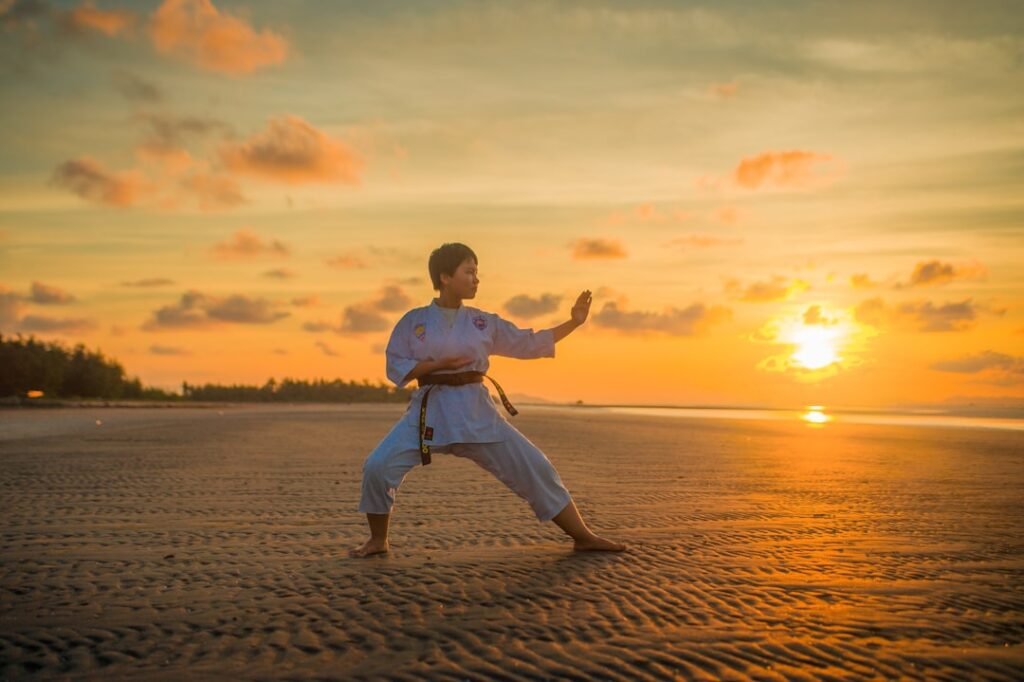
My 12-year-old walked off the tournament floor last spring with a fourth-place ribbon and a jaw set so tight I could see the effort it was taking him not to cry. He had trained hard. He had wanted that trophy. And he didn’t get it. What happened next — not that afternoon, but over the following weeks — is honestly one of the reasons I will never stop being grateful that our family found Tang Soo Do.
We talk a lot about what martial arts builds in kids — confidence, discipline, focus, physical strength. But there’s a quieter gift that doesn’t get nearly enough attention: the ability to lose with grace, learn from disappointment, and come back stronger. In a culture that increasingly shields children from failure, the dojang is one of the few places left where kids regularly face a real, honest result — and have to deal with it.
If you’re raising kids in Connecticut and you’ve been wondering whether martial arts competition is worth the stress and the entry fees, I want to make a case not just for winning — but for losing. Because learning to handle loss well might be the most important life skill Tang Soo Do ever gives your child.
Why Losing Is Part of the Curriculum
In Tang Soo Do, failure isn’t an accident of the program — it’s woven into the fabric of the training itself. Belt tests can be failed. Sparring matches are lost. Forms that felt perfect in practice fall apart under pressure. These aren’t bugs in the system. They’re features.
Master instructors have understood for centuries what modern psychology is only now catching up to: resilience isn’t built by avoiding hard things — it’s built by walking through them with support. The dojang provides exactly that structure. When a child loses a match, they bow to their opponent. They return to their instructor. They receive correction, not consolation. And then — crucially — they get back on the floor.
This is very different from a participation-trophy environment where every outcome is softened to the point of meaninglessness. Tang Soo Do respects children enough to let the result be real. And then it equips them to grow from it.
What Good Losing Actually Looks Like
I want to be honest here — good losing doesn’t come naturally to most kids, and it didn’t come naturally to mine either. My 15-year-old, who has been training the longest, will tell you that his earliest tournament losses made him want to quit entirely. My 10-year-old still struggles to mask his frustration in the moment. That’s normal. That’s human. The goal isn’t to raise children who feel nothing when they lose. The goal is to raise children who feel it — and then choose to respond with character anyway.
Over time, here’s what that actually looks like in practice:
- Bowing sincerely to an opponent who outperformed you — not as a formality, but as a genuine acknowledgment that they earned the win
- Asking your instructor what you can improve rather than looking for excuses about the judging or the bracket
- Returning to training the following week without being dragged back — choosing to show up even when motivation is low
- Cheering for teammates who placed when you didn’t, which takes real maturity and real love for the team
- Not carrying the loss into the next match — learning to reset mentally and compete fresh
None of these things happen overnight. But I have watched each of my boys develop these responses over time, and I can tell you — it changes who they are, not just on the tournament floor, but in the classroom, on sports teams, and at home.
The Role of the Instructor After a Loss
One thing I’ve come to deeply appreciate about quality Tang Soo Do instruction is how a good Sa Bum Nim (instructor) handles a student’s disappointment. The best ones don’t rush to comfort — they redirect. They ask questions. They point to specific, correctable things. They communicate, without ever saying it directly, that you are not your last result.
After my 12-year-old’s tournament, his instructor pulled him aside — not to say “you were robbed” or “you did great anyway” — but to say, “Here are two things I saw that we’re going to fix. Come to open mat on Thursday.” That was it. No drama. No false comfort. Just a path forward.
That is the culture of Tang Soo Do at its best. If you’re evaluating schools in Connecticut, watch how instructors respond when students fail — in tests, in sparring, in forms. That reaction tells you everything about the character of the program. You can find guidance on what separates strong programs from weak ones through resources like the World Tang Soo Do Association, which maintains standards for instructor training and student development across affiliated schools.
Faith, Failure, and Getting Back Up
As a Christian mom, I’ll be honest — I see something deeply spiritual in the way Tang Soo Do handles losing. There’s a verse I’ve come back to more than once as I’ve watched my boys navigate disappointment: “For the righteous falls seven times and rises again.” (Proverbs 24:16). That’s not a verse about never falling. It’s a verse about the rising.
The dojang teaches the rising. Not through motivational speeches, but through repetition, structure, and the expectation that you will come back. I’ve found that martial arts gives my boys a lived-out picture of something our faith teaches in the abstract — that failure is not final, that character is built in hard moments, and that getting back up is always the right next move.
That alignment between the values of Tang Soo Do and our family’s faith is something I don’t take for granted. It’s one of the reasons I genuinely believe martial arts is one of the best investments Connecticut families can make in their children’s character development.
How Parents Can Support Good Losing at Home
Here’s the part we don’t always want to hear: our kids take cues from us. If we’re visibly frustrated after a tournament loss — if we’re critiquing judges in the car on the way home or comparing scores out loud — we undermine everything the dojang just tried to teach. Our response to our child’s loss matters as much as their response to it.
A few things that have helped our family navigate post-tournament disappointment well:
- Give it an hour before you talk about what happened. Let the emotion settle. A car ride home is not the time for analysis.
- Ask open questions instead of offering opinions. “What do you think happened out there?” lands very differently than “I thought your form was better than theirs.”
- Celebrate the effort, not just outcomes — but don’t be fake about it. Kids know the difference between genuine encouragement and hollow cheerleading.
- Let the instructor do the coaching. Your job is parent. Their job is Sa Bum Nim. Trust the process and don’t overlap roles.
- Model it yourself. If you train alongside your kids — and I’d encourage every parent to try — let them see you receive correction gracefully. Let them watch you lose a sparring round and shake hands and laugh.
If you’re just starting out and wondering what tournament culture in Tang Soo Do actually looks like before you commit to competing, it’s worth reading up on how to prepare your child for their first Tang Soo Do tournament — including the mental side of competition that often gets overlooked in early training.
The Long Game
My 15-year-old — the one who once wanted to quit after an early tournament loss — recently helped coach a younger student through a disappointing belt test. I watched him sit down next to this frustrated little kid and say, almost word for word, what his own instructor had said to him years ago: “Here’s what we’re going to work on. Come back Thursday.”
That moment was worth every hard Saturday, every tournament entry fee, every tearful car ride home. Because what I saw wasn’t just a teenager being kind. I saw a young man who had internalized something true and important: failure is a teacher, not a verdict.
Tang Soo Do doesn’t promise your child will always win. It promises something better — that no matter what the result is, your child will know what to do next. For Connecticut families raising kids in a world that doesn’t always reward effort fairly, that kind of formation is priceless.
The research on martial arts and psychological resilience in youth continues to grow, and what it consistently shows aligns with what Tang Soo Do families already know from lived experience: structured martial arts training builds not just physical skill, but the emotional and mental tools kids need to face adversity with confidence.
Keep training. Keep showing up. The trophies are nice — but the character your child is building on that floor? That’s what lasts.
