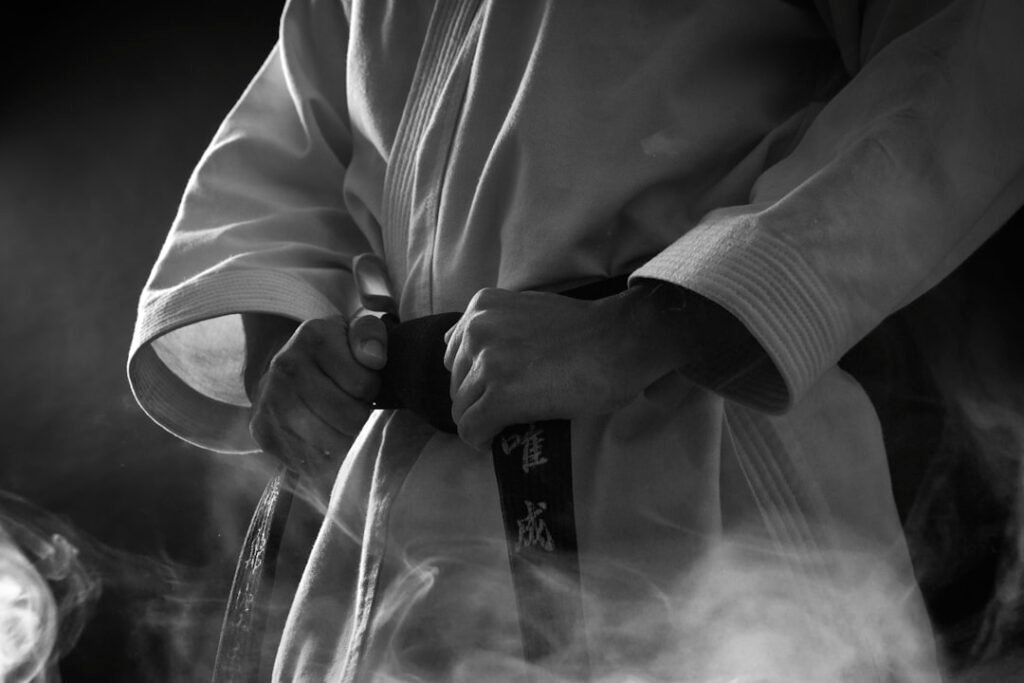
There’s a moment that every martial arts parent knows well. Your child is standing in front of the class, about to demonstrate a form they’ve been practicing for weeks. Their hands are trembling just slightly. The room is quiet. Every eye is on them. And then — they breathe, they bow, and they begin. Whatever happens next, something important is already happening: your child is learning how to perform under pressure.
This is one of those gifts that sneaks up on you when you first enroll your kids in Tang Soo Do. You think you’re signing them up for kicks and blocks and maybe some self-defense skills. And you get all of that. But what you don’t fully anticipate is how the training environment — structured, demanding, and deeply respectful — becomes one of the most powerful tools you have for raising kids who can handle hard things without falling apart.
I’ve watched this unfold with all four of my boys across very different ages and personalities. My 6-year-old is still figuring out how to stand still when Instructor addresses the class. My 15-year-old has competed at regional tournaments and come home with both medals and hard lessons. What they’re all gaining — at every level — is experience with pressure. Real pressure. And the skills to work through it.
Why Pressure Management Is a Life Skill, Not Just a Sports Skill
We live in a time when anxiety in children is at an all-time high. Kids are overwhelmed by academic expectations, social dynamics, and a constant stream of digital noise. What they often lack is not intelligence or potential — it’s experience with healthy stress. The kind of stress that comes from attempting something hard, falling short, and trying again.
Martial arts creates that environment deliberately. The dojang is designed to challenge students — not to break them, but to stretch them. Every belt test, every sparring round, every time a student must bow before the class and perform — those are intentional pressure moments. And repeated exposure to manageable pressure is exactly how children develop resilience.
Psychologists call this stress inoculation — the idea that small, controlled doses of stress help the brain and nervous system learn to regulate under pressure. Tang Soo Do has been doing this for centuries without using that term. The discipline, the repetition, the public performance — it’s all stress inoculation in a dobok.
The Dojang Creates Pressure in a Safe Container
What makes martial arts particularly effective is not just that it creates pressure, but that it creates pressure within a structured, supportive environment. The rules are clear. The expectations are consistent. The instructor is firm but fair. Students know exactly what is asked of them, which removes the chaos that makes pressure feel unmanageable.
My 10-year-old struggled significantly with anxiety around performance in his earlier years of training. Standing in front of the class made him want to disappear. But because our dojang has a culture of respect — where no one laughs at a mistake and everyone encourages each other — he slowly discovered that the mat was a safe place to be imperfect. That realization changed everything for him. He still gets nervous. But he doesn’t run from it anymore.
This is the beauty of what a quality Tang Soo Do school does. Finding the right martial arts school in Connecticut matters enormously here — because not every school creates that safe container. When the culture is right, the dojang becomes a place where children learn that pressure is survivable. That they are capable. That the nervous feeling before doing something hard is not a warning sign — it’s just energy that needs direction.
Specific Ways Tang Soo Do Builds Pressure Tolerance
- Belt testing: Testing is a formalized high-stakes performance moment. Students must demonstrate techniques in front of instructors and peers, knowing they may be asked to repeat or correct in real time. This mirrors academic testing, job interviews, and any future situation where they must perform on demand.
- Forms (hyungs): Performing a hyung alone in front of the class requires memorization, physical control, and mental focus — simultaneously. It’s not just physical; it’s deeply psychological. The student must hold composure while being observed.
- Sparring: Sparring introduces unpredictability. Your opponent doesn’t follow a script. Students must think, adapt, and execute technique under dynamic pressure. This is excellent training for real-world situations where there is no perfect plan.
- Competition: Tournament participation — even once — teaches children more about pressure management than most other experiences available to them. Win or lose, they have stood in an unfamiliar place, in front of strangers, and performed. That is enormous.
- Board breaking: There is something uniquely clarifying about breaking a board. You either commit fully or you don’t. Half-measures fail. This simple exercise teaches children to gather their focus and intention and release doubt — a lesson that transfers far beyond the mat.
Teaching Kids to Breathe Through It
One of the most practical things Tang Soo Do teaches — and one of the most transferable — is breath control. Instructors often cue students to breathe during forms and techniques. The kihap, the forceful exhalation during a strike, is more than a show of energy. It’s a physiological reset. It activates the parasympathetic nervous system. It tells the body: I am in control here.
My 12-year-old discovered this during belt testing. He told me afterward that when he felt his mind starting to blank, he took a breath before the next sequence, and it helped him find his place again. He figured that out himself — because the training had been building that instinct for months. Teaching children to breathe through pressure is one of the most valuable things a parent or instructor can do, and Tang Soo Do does it through every single class.
The World Tang Soo Do Association emphasizes mental discipline as a core pillar of the art — not just physical technique. That integration of mind and body training is precisely why Tang Soo Do is so effective at developing the whole child, not just a skilled kicker.
Faith, Grit, and the Long Game
As a Christian mom, I see so much alignment between what we teach our boys in faith and what they’re learning on the mat. Courage is not the absence of fear — it’s choosing to act faithfully in spite of it. Every time one of my boys steps into a pressure situation at the dojang and pushes through, they’re practicing a form of courage. They’re proving to themselves that they don’t have to be ruled by fear.
We talk about this at home. When my 15-year-old is stressed before a big test at school, I remind him that he has stood in front of judges at tournaments. He has tested for rank under pressure. His brain and body know how to do hard things. The dojang gave him evidence of his own capability, and that evidence doesn’t stay at the school — it travels with him everywhere.
That’s the long game of martial arts training. It’s not about the belt on the wall or the trophy on the shelf — though those are wonderful markers of progress. It’s about who your child is becoming through the accumulation of hard moments they chose not to avoid. Learning to handle setbacks in Tang Soo Do is part of that same journey — because pressure doesn’t always lead to a win, and how children respond to disappointment matters just as much.
Practical Tips for Parents Supporting Kids Through Pressure
- Normalize the nerves: Tell your child that nervousness before a belt test or performance is completely normal — even experienced black belts feel it. Reframe anxiety as excitement and readiness.
- Don’t over-coach at home: Trust the instructor. Your job before a big moment is to be the calm, steady presence — not the extra drilling session. Pressure at home adds to pressure on the mat.
- Debrief with curiosity, not grades: After a test or tournament, ask “What felt good?” before “How do you think you did?” Help them find their own evaluation rather than waiting for yours.
- Celebrate the attempt: Whether they passed or not, they showed up and tried. That matters more than the outcome at this stage of development.
- Let them sit with discomfort: Resist the urge to immediately fix or soothe. Some of the best growth happens in the quiet after a hard moment, when a child processes what they’re capable of.
The mat has taught my family more about grit, grace under pressure, and the slow work of becoming than almost anything else we’ve done together. If your child struggles with anxiety, avoidance, or crumbling under pressure — Tang Soo Do won’t fix that overnight. But over months and years of consistent training, they will accumulate something irreplaceable: a record of hard things they survived and grew from. And that record becomes the foundation of a confident, resilient person.
That’s worth every early morning, every sweaty uniform, and every nervous bow before the class begins.
