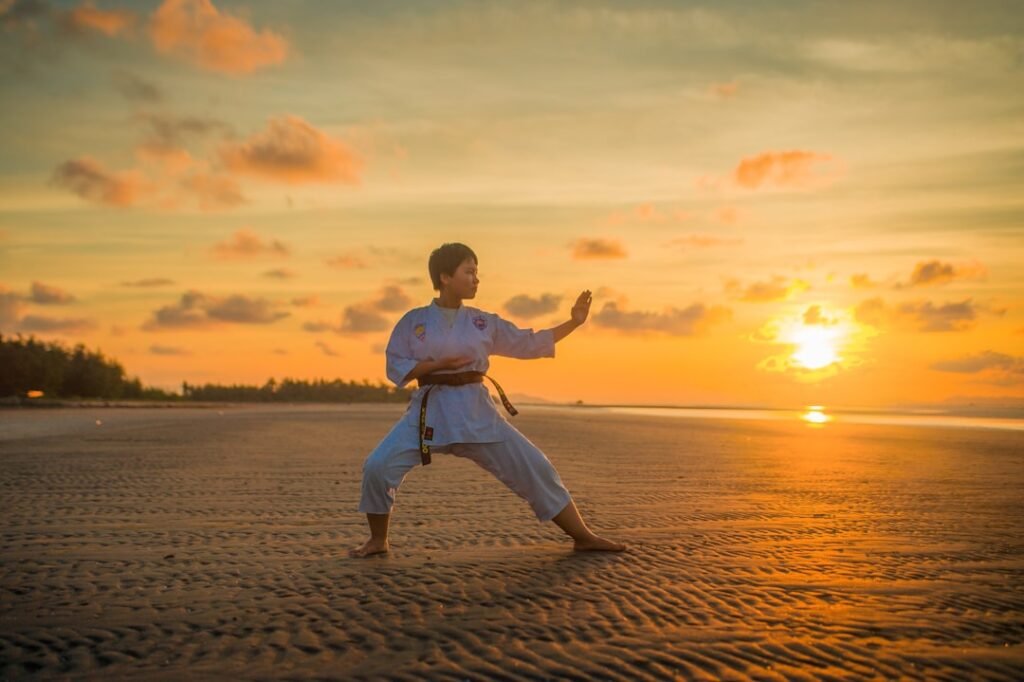
It started on an ordinary Tuesday evening at the dojang. My 10-year-old had come in from school distracted, a little cranky, and — if I’m being honest — about three seconds away from a meltdown over a homework assignment we’d argued about in the car. Forty-five minutes later, he walked off the mat calm, centered, and ready to eat dinner without drama. He hadn’t talked through his feelings. He hadn’t had a snack. He had just trained. And something in that structured, demanding, focused practice had genuinely reset him.
If you’re a parent, you already know that getting kids to focus — really focus — feels like one of the hardest jobs on the planet right now. Between school pressures, screens, and the general noise of modern family life, many Connecticut parents are searching for something that actually helps their children develop the ability to regulate their attention and emotions. What they might not realize is that a Tang Soo Do class may be doing exactly that, every single session.
This isn’t just a mom observation. The science backs it up — and once you understand what’s actually happening in your child’s brain during martial arts training, you’ll look at every class in a completely new way.
What Self-Regulation Actually Means — and Why It Matters
Self-regulation is more than just “behaving.” It’s the ability to manage your emotions, control your impulses, sustain your attention, and adjust your behavior based on what a situation calls for. It’s what helps a child stay seated during a test, wait their turn, handle frustration without exploding, and keep trying when something gets hard.
Pediatric researchers and educators increasingly recognize self-regulation as one of the most important predictors of long-term success — academically, socially, and professionally. And here’s what’s remarkable: it’s a skill that can be developed. It’s not fixed at birth. The right environments and experiences can genuinely strengthen a child’s capacity for focus and self-control over time.
Tang Soo Do, as a traditional Korean martial art rooted in discipline and respect, happens to be one of the most effective environments for building exactly these capacities — and it does it without feeling like a therapy session or a classroom exercise. It just feels like training.
The Dojang Is a Built-In Focus Training Environment
Think about what happens the moment your child steps onto the mat. They bow. They line up. They respond to commands in Korean. They are expected to maintain proper stance, track the instructor, execute techniques with precision, and do it all without chatting with their friend two spots down the line.
That is an enormous amount of sustained, directed attention — and it’s happening in a physical, engaging, high-interest environment, which research suggests is exactly where children learn best. The World Tang Soo Do Association places strong emphasis on mental discipline alongside physical technique, and that pairing is no accident. The founders of this art understood long before modern neuroscience confirmed it that training the body and training the mind are inseparable.
Every class my boys attend is structured around this dual development. Whether they’re drilling a punch combination, practicing their hyung, or working partner drills, they are being asked — constantly — to pay attention, hold their composure, and respond with precision. That’s not incidental to the training. It IS the training.
How Repetition and Ritual Build Neural Pathways
One of the reasons Tang Soo Do is so effective at building focus is that it relies heavily on structured repetition. You don’t just kick once and move on. You kick a hundred times, working to refine the form, the chamber, the follow-through. You practice the same hyung over and over until it becomes part of your body’s memory.
This kind of deliberate, repeated practice is exactly what builds strong neural pathways in the developing brain. Neuroscientists call it myelination — the process by which the brain strengthens connections that are used repeatedly. The more a child practices sustained, focused effort, the more naturally that capacity for focus becomes part of how their brain operates.
My 15-year-old has been training for years, and the difference in his ability to concentrate — on schoolwork, on tasks at home, on problems that require patience — is something our whole family has noticed. It didn’t happen overnight. It happened one class at a time, one form at a time, one belt at a time.
Breathing, Stillness, and the Power of the Kihap
There’s a moment in every Tang Soo Do class that I find quietly powerful: when the instructor calls the room to stillness before a drill or form. Students stand at attention, breathing, present. No fidgeting. No side conversations. Just readiness.
And then there’s the kihap — the focused shout that accompanies a technique. It might look like just a loud noise to someone watching from the lobby, but the kihap is actually a tool for channeling mental and physical energy in a single, coordinated burst. It requires breath control, body awareness, and intentional focus. Even my 6-year-old is learning through his kihap how to harness his energy rather than just scatter it in every direction.
These aren’t just martial arts quirks. They’re practical self-regulation tools that children carry with them beyond the dojang. Teaching a child to breathe deliberately before responding — to channel rather than react — is one of the most valuable gifts a training environment can give. As a mom who sees these habits starting to transfer into everyday life, I can tell you it’s real.
Emotional Regulation: Learning to Lose, Wait, and Try Again
Tang Soo Do also builds emotional self-regulation through the natural challenges of the training experience itself. Belt tests bring pressure. Partner drills bring frustration. Learning a new form that doesn’t come easily brings the temptation to quit. Navigating setbacks in martial arts is genuinely hard — and genuinely growth-producing.
When my 12-year-old struggles with a technique and has to keep trying under the instructor’s watchful eye in front of the whole class, he is learning something that no worksheet can teach: how to manage discomfort without shutting down. He’s learning that the frustrated feeling is not a signal to quit — it’s a signal that growth is happening. That reframe, practiced consistently, becomes a life skill.
From a faith perspective, this deeply resonates with me. Proverbs 25:28 describes a man without self-control as a city with broken-down walls. The dojang is one of the places where my boys are actively building those walls — learning to govern themselves, manage their impulses, and persist through difficulty. I see it as part of raising young men of character.
What This Looks Like for Different Ages
One of the things I love about Tang Soo Do is that it meets children where they are developmentally. The focus and self-regulation benefits show up differently at different ages, but they show up consistently:
- Younger children (ages 5–7) begin developing the ability to follow multi-step instructions, wait their turn, and stay on task for short periods. The structured class environment gives them a predictable framework that helps their nervous systems feel safe enough to practice focus.
- Middle childhood (ages 8–12) is when children begin to show real growth in sustained attention and emotional regulation. The increasing complexity of forms, combinations, and partner work challenges them in exactly the right ways at this stage.
- Teenagers benefit enormously from the discipline of martial arts as their brains undergo the significant remodeling of adolescence. Having an anchor of structured, demanding, respect-based practice during these years is something I genuinely thank God for with my 15-year-old.
The American Academy of Pediatrics has noted that physical activity involving complex movement and social interaction supports cognitive development across childhood — which is a strong endorsement of exactly what a quality martial arts program provides. You can explore their research on HealthyChildren.org for more context on how movement supports brain development.
Bringing It Home: What Parents Can Do to Reinforce These Skills
The dojang does the heavy lifting, but parents can support and amplify these benefits at home. A few things that have worked in our family:
- Using the same language your child hears in class — things like “focus,” “attention,” and “reset” — when you want them to redirect their energy at home.
- Encouraging brief at-home practice, even just five minutes of forms or stances, when a child is feeling scattered or overstimulated.
- Celebrating improvements in focus and self-control specifically — not just belt promotions — so children understand that mental discipline is the real achievement.
- Staying consistent with class attendance, because the cumulative effect of repeated training is what produces lasting change in the brain.
If you’re still in the research phase of finding the right program for your family, knowing what to look for in a quality martial arts school can help you find a dojang where instructors genuinely understand and prioritize this kind of whole-child development.
The Long Game Is Worth It
Raising focused, self-regulated children isn’t a quick fix. It’s a long investment — made class by class, belt by belt, year by year. But as a mom who has watched four boys grow through Tang Soo Do at different stages, I can tell you that the investment pays off in ways that go far beyond kicks and forms.
The child who can breathe before he reacts. The teenager who can sit with discomfort without giving up. The young man who knows how to govern himself. That’s what we’re really building on the mat. And there is nothing more worth showing up for.
