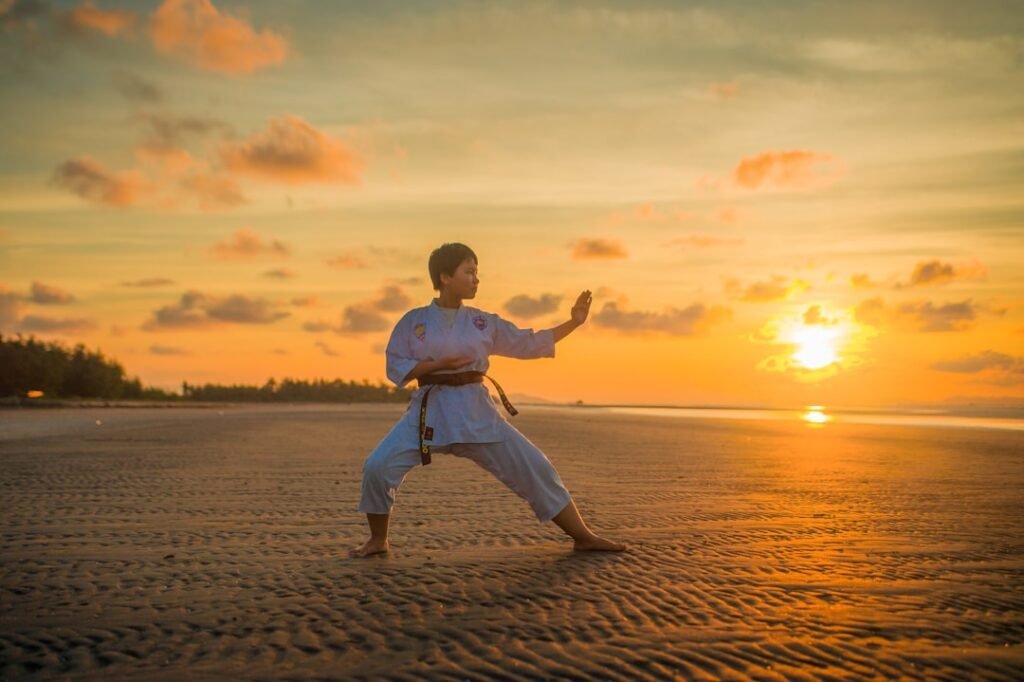
If you’ve ever watched a six-year-old try to sit still for more than thirty seconds, you already understand the challenge. Now imagine that same child standing at attention in a dojang, eyes forward, hands at his sides, waiting quietly for instruction. That’s not magic — that’s Tang Soo Do. And as a mom who has watched all four of my boys go through exactly that transformation, I can tell you the change is real, measurable, and it carries way beyond the mat.
We talk a lot in the martial arts community about confidence and discipline, but there’s actually a fascinating body of research behind why structured martial arts training works so well for developing focus and self-control in children. Understanding the science helped me appreciate what our instructors were doing at a deeper level — and it might help you see your child’s training through a completely new lens.
The Brain Is a Muscle Too — and Martial Arts Works It Hard
Here’s something I didn’t fully appreciate when we first started training as a family: every time a child practices a Tang Soo Do form, responds to a command, or waits their turn in line, they are actively exercising the prefrontal cortex — the part of the brain responsible for decision-making, impulse control, and focused attention. This region is still developing well into a person’s mid-twenties, which means the habits and neural pathways formed during childhood and adolescence have a lasting impact on how a person thinks and regulates themselves.
The structure of a martial arts class is almost perfectly designed to challenge this developing part of the brain. Children must listen carefully, remember sequences of movement, control their physical responses, and respond appropriately to their environment — all at the same time. That’s a full cognitive workout happening inside every single class.
Research published by organizations like the Amateur Athletic Union and various child development researchers has consistently highlighted martial arts as one of the most effective extracurricular activities for improving attention and executive function in children — including those who struggle with focus-related challenges. That’s not a small thing. That’s life-changing for a lot of families.
Inhibitory Control: Learning to Stop Before You Act
One of the most powerful self-regulation skills a child can develop is inhibitory control — the ability to pause before reacting. In Tang Soo Do, we call it discipline. In brain science, it’s the ability to override an impulse with a conscious choice.
Think about the drills that seem simple on the surface: a student is told to hold a stance and not move until commanded. Or they must stop a strike just short of their partner’s face — controlled power, not wild swinging. These aren’t just technique drills. They are direct, repeated practice of inhibitory control. Every class, multiple times per class, your child is practicing the art of stopping themselves.
My 10-year-old used to have a temper that would flare up fast. Not a behavior problem exactly — just a kid with a lot of energy and big emotions who hadn’t learned to pause. Tang Soo Do gave him a physical outlet, yes, but more importantly it gave him a framework. We started hearing “Ye!” at home in a completely different context — him catching himself before reacting. That’s inhibitory control in action, and it came directly from the mat.
Sequential Learning and Working Memory
Forms — called hyungs in Tang Soo Do — are one of the most underrated cognitive tools in martial arts training. A hyung is a memorized sequence of techniques performed solo against imaginary opponents. Learning one requires a student to hold multiple pieces of information in working memory, execute them in precise order, and self-correct in real time.
This is exactly the kind of mental demand that strengthens working memory capacity over time. And working memory isn’t just useful for remembering a hyung — it’s directly tied to academic performance, reading comprehension, and mathematical reasoning. When my 12-year-old sits down to work through a complex problem at school, the same mental muscles he uses to run through a hyung from beginning to end are working for him.
If you’re curious about how the World Tang Soo Do Association structures curriculum to support this progressive learning, their official site gives a great overview of how rank progression layers complexity intentionally — always building on what came before.
Breathing, Body Awareness, and Emotional Regulation
One of the more quietly powerful aspects of Tang Soo Do training is breath. The kihap — that sharp, focused exhale-shout that accompanies a technique — is more than tradition. It’s a deliberate connection between breath and action that trains children to regulate their physical state. Controlled breathing is one of the most direct ways humans can calm the nervous system and move out of a stress response.
Children who learn to breathe with intention during training carry that skill into their daily lives. My 15-year-old has talked about using controlled breathing before tests at school and before athletic competitions in other sports. It started as a habit formed in the dojang, and it became a genuine coping tool. That kind of body awareness is something we deeply value in our family — there’s even a scriptural resonance to it. Caring for your body and mind as a temple, learning to be still and self-possessed — these ideas run through our faith and through our training in beautiful parallel.
Why Repetition Isn’t Boring — It’s Building
One of the most common things I hear from parents who are considering martial arts is: “Won’t my kid get bored doing the same kicks and blocks over and over?” It’s a fair question. But what looks like repetition from the outside is actually deep practice — the kind that builds automaticity.
When a skill becomes automatic, the brain frees up cognitive resources that can be redirected toward higher-level thinking. A beginner has to consciously think about every part of a front kick. An intermediate student executes it without thinking, which means their mind is free to read their environment, respond to a partner, or layer in new complexity. Repetition isn’t boring — it’s the process by which the brain moves a skill from effortful to effortless.
This is one reason knowing what to expect in early Tang Soo Do training matters so much for new families. When parents understand that the “boring” basics are actually doing profound neurological work, they’re much more likely to encourage their children through the early stages rather than pulling them out right before the growth kicks in.
The Role of Respect and Structure in Building Self-Control
Discipline can’t be separated from structure, and structure in Tang Soo Do is built on a foundation of respect. Bowing when you enter. Addressing instructors properly. Waiting your turn. These aren’t arbitrary rules — they are the container that makes focused, safe, productive training possible.
When children are surrounded by clear, consistent expectations delivered by trustworthy adults, their brains literally feel safer. And when the brain feels safe, it can learn. The predictability of dojang culture — the rituals, the commands, the clear hierarchy — creates the exact conditions under which children thrive cognitively and emotionally.
My 6-year-old’s teacher told me early on that the goal in those first months of training isn’t technique — it’s listening. Teaching a young child to listen to instruction, to wait, and to respond appropriately is the entire foundation. Everything else builds on that. Understanding that priority completely reframed how I saw his classes, and it made me a better training parent.
What This Means for Your Family
Whether your child is a natural high-energy kid, a quiet one who needs encouragement to push limits, or somewhere in between — Tang Soo Do meets them where they are and builds the exact mental and emotional tools they need to grow. Focus isn’t a personality trait that some kids have and others don’t. It’s a skill. Self-control isn’t something children either possess or lack. It’s trained, strengthened, and deepened over time through exactly the kind of consistent, structured, demanding practice that martial arts provides.
We have watched this play out across four completely different kids in our household. Same training, same art, four different growth journeys — all of them real, all of them meaningful. And if you want to explore more about the broader developmental benefits martial arts offers children at different stages, there’s so much more to unpack.
The dojang is more than a place to learn kicks and forms. It’s a place where young minds learn to govern themselves — and there is nothing more valuable you can give a child than that.
