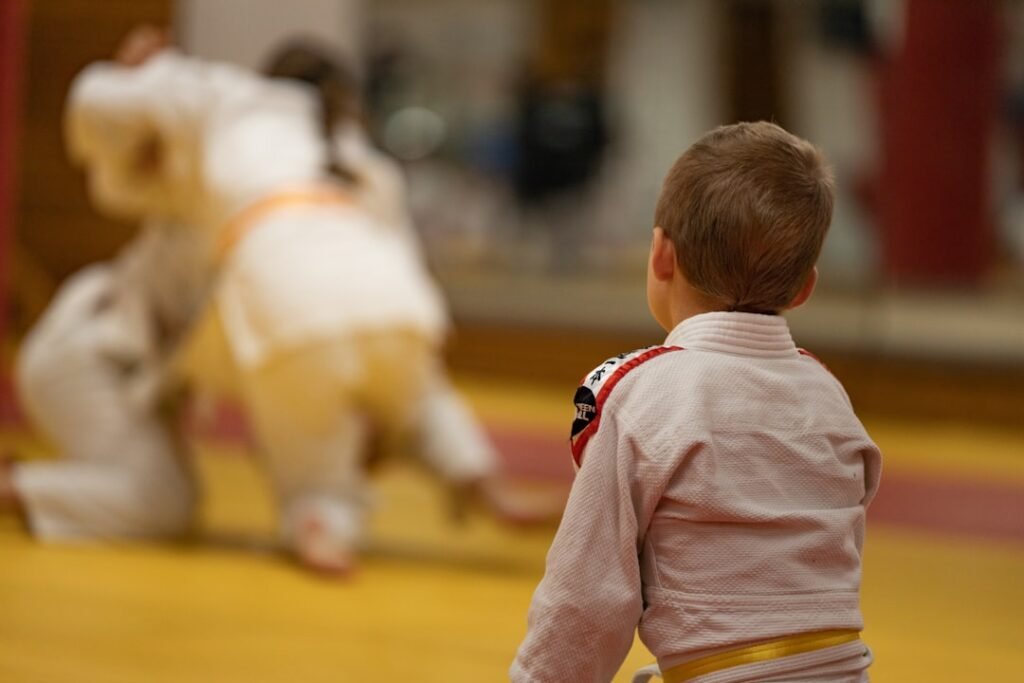
Every spring, the same conversation happens in our house. Soccer signups. Baseball tryouts. Basketball league registration. With four boys at different ages and stages, we are no strangers to the blur of cleats, equipment bags, and Saturday morning schedules. And every single season, I watch my sons step onto whatever field or court they’re competing on and think — Tang Soo Do made them better at this.
It’s not something I expected when we first started training as a family. I signed us up for martial arts because I wanted my boys to grow in discipline and confidence, not because I was chasing some athletic edge. But over time, it became impossible to ignore. The footwork. The focus. The way they recover when something goes wrong. The mental toughness when the score isn’t in their favor. All of it traces back to the dojang.
If you’re a Connecticut family weighing whether martial arts fits into an already packed sports schedule, I want to make the case that Tang Soo Do doesn’t compete with your child’s other activities — it quietly elevates all of them.
The Physical Foundation That Transfers Everywhere
Tang Soo Do builds a type of athletic foundation that most sport-specific training simply doesn’t address. When kids train in a single sport year-round, they develop strength and skill in a narrow range of movement patterns. Martial arts fills in the gaps in ways that coaches in other sports genuinely notice.
Here’s what consistent Tang Soo Do training develops physically:
- Core strength and stability — Every kick, block, and strike generates power from the center of the body. Kids who train regularly develop functional core strength that improves performance in virtually every other sport.
- Balance and body control — Executing a proper side kick or performing a hyung (form) requires a level of balance and spatial awareness that directly translates to sports like soccer, gymnastics, and basketball.
- Flexibility — The stretching culture in Tang Soo Do is consistent and intentional. Flexible athletes are less prone to injury, recover faster, and move more efficiently.
- Explosive speed and agility — The quick transitions in sparring and drills develop fast-twitch muscle response that shows up in sprint starts, lateral cuts, and reaction time on any field or court.
- Coordination and timing — Learning to time a block against an oncoming strike, or land a technique with precision, trains hand-eye and full-body coordination in a dynamic, unpredictable environment.
My 15-year-old plays soccer at a competitive level, and his coach has commented more than once on his ability to recover his footing and stay composed under pressure. That’s not a soccer skill — that’s a dojang skill that came with him onto the field.
The Mental Game Is Where Martial Arts Really Shines
Physical ability only takes an athlete so far. Anyone who has watched youth sports long enough knows that the kids who rise are usually the ones with the mental edge — the ones who stay focused when things get hard, who don’t crumble under pressure, who can lose a point and immediately reset. That mental discipline is built deliberately in Tang Soo Do.
In the dojang, we practice what I’d describe as present-moment focus. You can’t perform a hyung well if your mind is somewhere else. You can’t spar effectively if you’re still thinking about the last exchange. Every class demands that you bring your full attention to what’s in front of you, right now. That’s a transferable mental skill, and it’s one that takes months and years of consistent training to develop.
My 12-year-old wrestles in the winter, and his coach pulled me aside to say he had one of the best mental resets on the team — meaning when he got taken down, he didn’t spiral. He got back up. I smiled, because I knew exactly where that came from. We’ve watched him practice that reset in sparring dozens of times.
The World Tang Soo Do Association emphasizes mental discipline and character development as core pillars of the art — and it’s not just philosophy. Those values get trained into the body through repetition, just like technique does.
Respect and Coachability — Two Things Every Team Needs
Here’s something coaches rarely talk about publicly but privately say all the time: they would rather have a coachable athlete with average talent than a gifted athlete who won’t listen. Coachability — the ability to receive correction, apply it immediately, and respect the authority of the coach — is something Tang Soo Do trains directly and consistently.
From the very first class, students learn to bow when entering and leaving the dojang, to address instructors with respect, to receive criticism without attitude, and to follow instruction with full effort. These are not just martial arts customs. They are habits of character that follow a child into every team sport they play.
When my 10-year-old joined his baseball team, his coach told me he was one of the most attentive kids at practice. He listened on the first instruction, not the fifth. He didn’t complain when he was asked to run drills again. That comes from years of dojang culture, where listening and effort are simply expected — not optional.
If you’re thinking about what the right martial arts environment looks like for building this kind of character, knowing what to look for in a quality martial arts school can help you find the right fit for your family in Connecticut.
Injury Prevention and Body Awareness
One underrated benefit that doesn’t get talked about enough is how martial arts training reduces injury rates in other sports. When children understand how their bodies move — when they have genuine proprioception and muscle control — they are less likely to land awkwardly, overextend a joint, or get hurt in a fall.
Tang Soo Do teaches falling safely, controlling momentum, and understanding body mechanics in a way that most youth sports programs simply don’t have time for. My 6-year-old has already had more intentional training on how to fall and roll safely than most kids twice his age. That kind of body literacy matters, especially as kids move into contact sports.
According to research compiled by organizations like the Amateur Athletic Union, youth athletes who cross-train in multiple movement disciplines show lower injury rates overall. Martial arts, with its full-body conditioning and emphasis on controlled movement, fits that cross-training profile exceptionally well.
Goal Setting and the Long Game
Team sports often operate on a seasonal cycle — you win, you lose, the season ends, and you start over. Martial arts works differently. The belt progression system gives students a long-term, incremental goal structure that teaches them how to work toward something over months and years, not just weeks.
That long-game mentality shapes athletes in powerful ways. A child who has worked for two years toward a belt promotion understands delayed gratification in their bones. They know that progress isn’t always visible day to day. They know that showing up consistently — even when it’s hard, even when they’re not improving quickly — is what builds something lasting.
I’ve watched this play out beautifully in how my sons approach off-seasons in their other sports. They don’t stop training mentally. They understand that the work you do between seasons is what determines who you are when the season starts. That’s a martial arts lesson dressed in athletic clothes.
For families exploring what belt progression in Tang Soo Do looks like and how it maps to a child’s development, that framework itself is one of the most valuable athletic tools you can give a young person.
A Word to Families Worried About Overcommitting
I hear this concern often from parents in Connecticut who love the idea of martial arts but worry about adding one more thing to an already full schedule. I get it — I really do. Managing four boys across multiple sports and activities is a constant puzzle of logistics and energy.
What I’ve found is that Tang Soo Do doesn’t drain the schedule the way a second team sport does. There are no away games, no travel tournaments you’re locked into, no mandatory team practices six days a week. You train at a pace that works for your family, and the benefits compound quietly in the background. Many families find that martial arts actually simplifies their schedule because it’s one consistent, year-round activity that supports everything else rather than competing with it.
From a faith perspective, I also love that martial arts gives my boys a space where the values we teach at home — humility, perseverance, respect, honor — are reinforced by their instructors every single week. Proverbs 22:6 says to train up a child in the way they should go, and I believe the dojang is one of the places where that training happens, alongside church, home, and school. It’s a community of adults pouring good things into my kids, and as a mom, I am deeply grateful for that.
Whether your child plays soccer, baseball, basketball, lacrosse, or competes in gymnastics, Tang Soo Do will make them better at it — not by replacing their sport, but by building the physical, mental, and character foundation that every great athlete needs. The dojang isn’t competition for your child’s other activities. It’s the training ground that quietly makes all of them possible.
