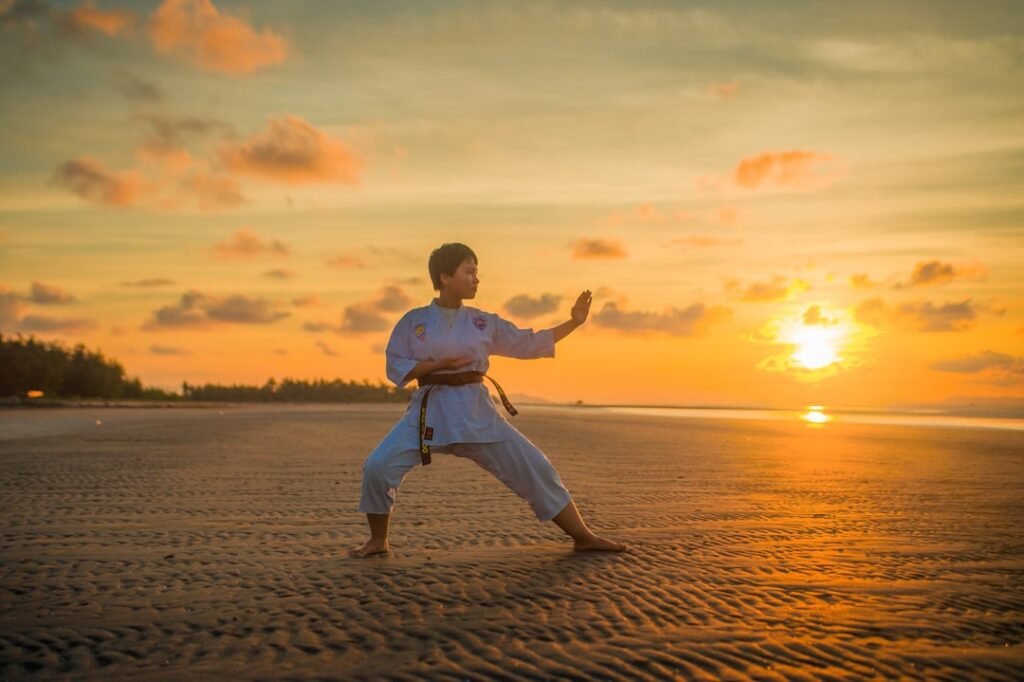
My 10-year-old used to freeze. Not in sparring — in life. Before a school presentation, before a baseball tryout, before anything that had an audience and expectations attached to it. His hands would shake, his voice would drop, and that bright, confident kid I knew at home would just… disappear. I didn’t fully understand what was happening until I watched him stand at the edge of the mat before his first belt test, visibly trembling, and then step forward anyway and execute every technique cleanly. That moment changed how I understood what Tang Soo Do was doing for him — and for all four of my boys.
Anxiety in children is more common than most parents realize. It shows up differently depending on the child — some kids shut down, others act out, and some just quietly carry a weight that’s too heavy for their age. What I’ve discovered through years of training alongside my sons is that the martial arts dojang creates a genuinely unique environment for learning to manage that weight. Not by eliminating pressure, but by teaching kids how to breathe through it, stand in it, and come out the other side stronger.
Why Pressure in the Dojang Is Actually a Gift
Here’s something that might sound counterintuitive: one of the most valuable things about Tang Soo Do is that it puts kids under pressure regularly and on purpose. Belt tests. Sparring matches. Performing hyungs in front of instructors and peers. Breaking boards. These aren’t just martial arts milestones — they’re controlled doses of stress that train the nervous system to respond rather than collapse.
Sports psychologists call this stress inoculation — the idea that gradually exposing children to manageable challenges builds their capacity to handle bigger ones. What Tang Soo Do does brilliantly is that this exposure is structured. The expectations are clear. The progression is defined. There’s always a next step, always a way forward. For a child who experiences anxiety, that kind of clear framework is genuinely calming — even when the activity itself is intense.
My 12-year-old is wired very differently from my 10-year-old. He’s competitive and rarely shows nerves outwardly, but he used to crumble internally when he felt he wasn’t the best in the room. Tang Soo Do has a beautiful way of reframing that. You’re not competing against the other students — you’re competing against the version of yourself from last week. That shift in perspective took time, but when it clicked for him, it changed everything about how he handles pressure in school and in athletics.
The Role of Breath, Ritual, and Repetition
One of the things I love most about the structure of a Tang Soo Do class is the ritual embedded in every session. We bow in. We line up by rank. We recite the student creed. We warm up in sync. For anxious kids, this kind of predictable, orderly ritual is deeply regulating. It tells the nervous system: you know this place, you know these people, you are safe here.
Breathing is another tool that gets woven into training in ways that feel natural rather than clinical. The kihap — that focused shout that accompanies a strike — isn’t just about power generation. It forces a full exhale and a moment of full presence. You cannot kihap and ruminate at the same time. My 6-year-old, who is still learning to regulate big emotions, has genuinely benefited from this. When he’s upset at home, I’ve started asking him to take a “kihap breath” — a big inhale and a forceful exhale — and it works. His instructors would probably smile at that.
The repetition of techniques and forms also plays a role that’s easy to underestimate. Drilling the same movement hundreds of times builds something called procedural memory — your body knows what to do before your anxious brain has a chance to interfere. This is enormously helpful for kids who tend to overthink. When my 10-year-old steps onto the mat for a test now, his hands don’t shake the way they used to. His body knows the material. His mind can settle because his muscle memory is carrying him.
What Belt Testing Teaches About Performing Under Pressure
Belt tests are the crucible. They are the moment when everything practiced in private gets demonstrated in public, in front of judges, under time pressure, with real consequences if you’re not ready. For kids who struggle with anxiety, this sounds terrifying — and honestly, the first few times, it often is. But that’s exactly why it’s so transformative.
What children learn through belt testing is not just martial arts technique. They learn that they can be nervous and perform. They learn that shaky hands don’t mean failure. They learn that the preparation they put in is more powerful than the fear they feel in the moment. These are lessons that transfer directly to standardized testing, to athletic competition, to school performances, and eventually to job interviews and adult pressures we can’t fully anticipate yet.
If your child has struggled with test anxiety specifically, I’d encourage you to read more about how we approach belt test preparation in Tang Soo Do — because the mindset work is just as important as the physical readiness. The two go hand in hand, and a good instructor will address both.
The Instructor Relationship Matters More Than You Think
For anxious children, the relationship with their Tang Soo Do instructor can be quietly powerful. A skilled instructor knows how to push without crushing, challenge without humiliating, and correct without discouraging. That balance is an art form in itself. What I’ve seen in our dojang is that children who feel truly seen and respected by their instructor develop a kind of grounded confidence that’s different from the kind that comes from winning or external praise.
My 15-year-old — who is now a senior student and occasionally helps with the younger kids — told me recently that what kept him training through the awkward middle years was that his instructor always made him feel capable even when he felt lost. That consistency of belief from a trusted adult is something anxious kids carry with them in ways that are hard to measure but impossible to miss.
The World Tang Soo Do Association maintains standards for instructor certification and curriculum that help ensure this kind of quality across schools. When you’re choosing a dojang for your child, asking about instructor credentials and how they approach student development is always worth the conversation.
Faith, Fear, and Moving Forward Anyway
I’ll be honest — there are moments in this journey where my faith and my role as a martial arts mom intersect in ways I didn’t expect. We talk in our home about courage not as the absence of fear, but as choosing to move forward despite it. That’s a deeply Biblical concept, and it’s also exactly what Tang Soo Do asks of students every single time they step onto the mat.
When my 10-year-old stood trembling at that belt test and stepped forward anyway, he was practicing courage in its purest form. He didn’t know at the time that he was living out something ancient and meaningful — he just knew he had worked hard and it was time. But I knew. And I was so proud I could barely breathe.
Anxiety doesn’t disappear through martial arts training. I want to be honest about that. But what changes is a child’s relationship to it. Instead of feeling controlled by fear, they begin to feel capable of acting in spite of fear. That shift — that move from victim to agent — is one of the most profound gifts the martial arts can give a child. And it starts on a mat, in a clean white dobok, with one step forward.
Practical Tips for Parents of Anxious Kids Starting Tang Soo Do
- Start with observation. Many schools allow new students to watch a class before joining. For anxious children, this preview reduces the unknown and lowers the barrier to entry significantly.
- Talk to the instructor directly. Let them know your child experiences anxiety. Good instructors appreciate this context and will adjust their approach thoughtfully.
- Celebrate courage, not just performance. After class, ask “What did you try?” rather than “How did you do?” It reframes success around effort and bravery.
- Be patient with the pace. Progress in Tang Soo Do is gradual by design. For anxious kids, slow and steady is exactly right — it builds genuine confidence rather than rushed performance.
- Train alongside them if you can. There is something uniquely powerful about a parent who steps onto the mat too. It says: this is worth doing, and you are not alone.
The Amateur Athletic Union has long recognized the developmental benefits of martial arts for youth, and the research continues to grow. But honestly, the most compelling evidence I have isn’t in a study — it’s in the four boys I watch grow stronger, braver, and more grounded every single week on that mat.
If your child is anxious, uncertain, or just needs a place where pressure has a purpose and effort is always honored — Tang Soo Do might be exactly what they’ve been waiting for. Come find out.
