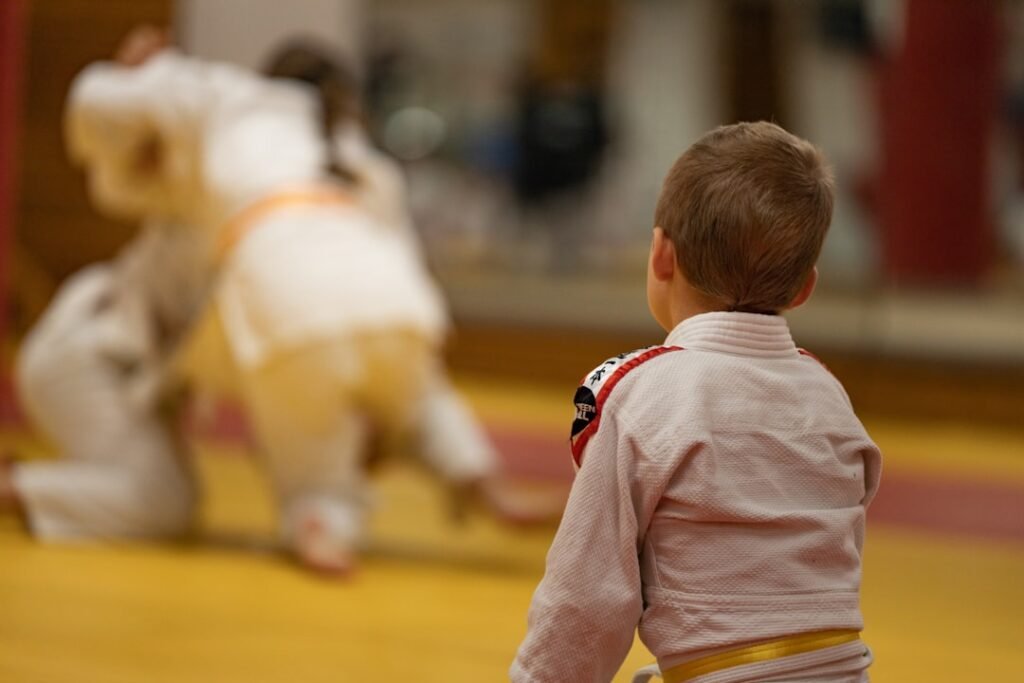
My 12-year-old stood at the edge of the competition floor, hands shaking, eyes darting around the gymnasium. It was his first real tournament, and every ounce of months of training seemed to evaporate the moment the room filled with unfamiliar faces, judges, and the echo of sparring gear hitting the mat. I watched from the sidelines, quietly praying, knowing there was nothing more I could do at that point. The preparation was done. What happened next was entirely about what was living inside of him.
That moment — that edge-of-the-floor moment — is something almost every martial arts family will recognize. And I want to talk about it honestly, because tournament preparation in Tang Soo Do is so much more than practicing your hyung until it’s clean or drilling your sparring combinations until they’re automatic. It’s about building a competition mindset that doesn’t just show up on tournament day. It shows up in the classroom, in relationships, in how your child handles pressure for the rest of their life.
What a Tournament Actually Tests in Tang Soo Do
When families first ask me about Tang Soo Do tournaments, they usually want to know about the logistics — what divisions are there, how is scoring done, what should my child wear? Those are fair questions and important ones. But the deeper answer to “what does a tournament test” is this: it tests the whole student, not just the technique.
In Tang Soo Do competition, students typically participate in forms (hyungs), sparring, and sometimes breaking. Each of those categories demands something different from a young competitor. Forms require precision, memory, power, and presence of mind under pressure. Sparring demands split-second decision-making, controlled aggression, and the ability to recover from a point loss without falling apart. Breaking challenges a student to trust their technique completely at a moment when doubt is loudest.
None of those things are purely physical. They are all, at their core, mental and emotional challenges wrapped in a physical container. That’s what makes tournament training so valuable even for the kids who have no interest in winning medals — it’s a controlled environment for practicing how to perform under pressure.
Starting Tournament Prep the Right Way
We start talking about tournaments in our household weeks, sometimes months, before the event. Not because we’re obsessive about winning — we’re genuinely not — but because preparation is a discipline in itself, and I want my boys to understand that being ready is an act of respect. Respect for the art, for the judges, for the other competitors, and for themselves.
Here’s what effective tournament preparation looks like in our home and in our dojang:
- Lock in the forms early. Your child should know their hyung well enough to perform it half-asleep before tournament day. Repetition builds trust, and trust is what holds technique together when nerves hit.
- Train in “performance mode.” Have your child perform their form as if they’re being judged — one time through, no stopping to fix mistakes, bowing in and bowing out. Simulate the pressure so it doesn’t feel foreign on competition day.
- Work on sparring combinations, not just free sparring. Drilling specific two- and three-step combinations builds the kind of automatic response that kicks in when your brain is flooded with adrenaline.
- Talk about the mental side. Don’t ignore it. Ask your child what they’re nervous about specifically, and work through it together. Naming the fear takes some of its power away.
- Visit or research the venue when possible. Unfamiliar environments spike anxiety. If you can walk your child through what the tournament space looks and feels like beforehand, you reduce the number of unknowns they have to process on competition day.
The World Tang Soo Do Association hosts and sanctions tournaments that follow consistent rules and structure, which is genuinely helpful for families preparing for their first competition. Knowing the framework your child will compete within takes some of the mystery out of the process.
Managing Nerves Without Squashing Them
Here’s something I’ve learned from watching all four of my boys at different stages: nerves are not the enemy. The goal is never to eliminate competition anxiety — it’s to teach your child to channel it.
Adrenaline, when managed, sharpens focus and increases physical performance. The problem is that most kids (and plenty of adults) experience adrenaline as panic rather than as fuel. Part of tournament preparation is literally practicing how to breathe, how to reset, and how to move from anxious energy into focused energy.
My 10-year-old has a tendency to go wide-eyed and stiff when he’s nervous — his forms get choppy and his kihaps get quiet. We’ve worked specifically on his warm-up routine: deep breathing, a few light stretches, shaking out his hands, and saying a short personal prayer before stepping onto the floor. That ritual is his anchor. It signals to his nervous system that this is a known situation, not a threat. Over time, that kind of routine becomes a genuine tool for mental regulation.
If you want to go deeper on building confidence in young martial artists more broadly, I’ve written about managing nerves and building confidence through martial arts training — a lot of those strategies apply directly to tournament situations as well.
How to Talk to Your Child About Winning and Losing
This is the part of tournament prep that most parents underestimate, and it’s honestly the most important conversation you’ll have. Your child is going to lose sometimes. They’re going to place third when they hoped for first. They’re going to get scored against in sparring and feel the sting of it. What you say in that moment matters enormously.
I don’t tell my boys that winning doesn’t matter, because that’s not entirely honest. Competition is designed to have a winner, and it’s okay for your child to want to win and to feel disappointed when they don’t. What I do tell them is that the measure of a martial artist — and honestly, the measure of a person — is how they carry themselves when things don’t go their way.
In our faith, we talk a lot about character being formed in adversity, not in comfort. The dojang is one of the best places I know of to let that truth become something my kids actually experience and not just hear. A tournament loss, handled well, is a faith lesson about humility, perseverance, and the long view. A tournament win, handled well, is a lesson about gratitude and staying grounded.
Whatever the outcome, our post-tournament conversation always comes back to the same questions: Did you give your best effort? Did you represent yourself and our family well? What did you learn? Those three questions reframe every competition as something that always has a positive outcome available, regardless of the score.
The Long Game — What Competition Builds Over Years
My 15-year-old has competed in Tang Soo Do tournaments for years now. When I compare who he was at his first tournament to who he is now, the growth has very little to do with how many medals are hanging on his wall. It has everything to do with how he walks into a room, how he handles pressure, and how he treats the people he competes against.
The AAU Martial Arts program offers competitive opportunities for young martial artists that extend beyond individual schools and regions, and I’ve seen firsthand how exposure to broader competition helps kids grow in ways that local tournaments alone can’t always provide. The diversity of competitors, the scale of the environment, the stakes — it all demands more from a young athlete in the best possible way.
What tournament training ultimately builds is this: a young person who knows that they can face something hard and come out the other side intact. That knowledge doesn’t stay in the gym. It walks into school with them, into team sports, into job interviews, into relationships. The discipline, the resilience, the ability to perform under pressure — these are not martial arts skills. They are life skills with a Tang Soo Do origin story.
One Last Word to the Nervous Parent on the Sidelines
If you’re standing at the edge of that gymnasium watching your child walk out onto the competition floor for the first time, I want you to know something: your presence matters more than any technique tip you could ever give them. The fact that you showed up, that you’re invested, that you made this journey with them — your child feels that. Let them compete. Let them struggle. Let them grow. And when it’s over — win or lose — let them see your pride, not in the result, but in them.
That’s what Tang Soo Do tournaments are really for. Not the trophies. The people.
