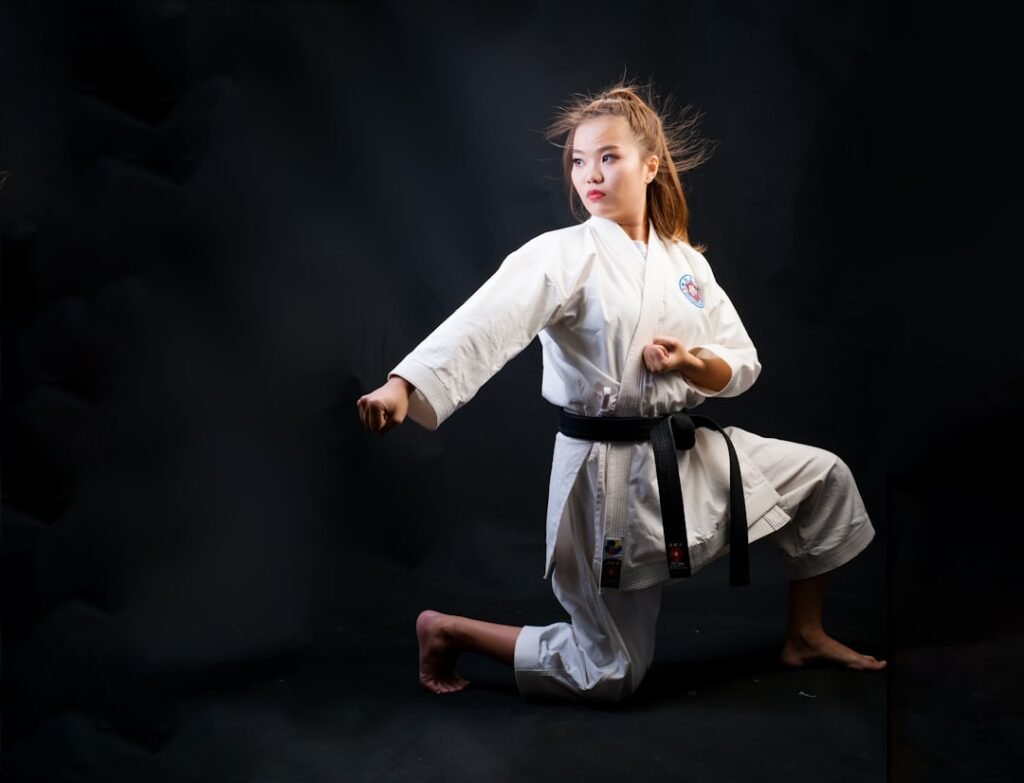
There is a moment every martial arts parent knows well. Your child is standing in the center of the floor — belt test, tournament, sparring match, it doesn’t matter — and you can see it happen in real time. The jaw tightens. The eyes go wide. The breath gets shallow. And everything they’ve practiced a hundred times suddenly feels very far away. I’ve watched all four of my boys go through it, and I’ve been through it myself. That feeling of pressure, of being on, of knowing that this moment counts — it doesn’t go away just because you’re prepared. But what Tang Soo Do teaches, slowly and beautifully over time, is that you don’t have to run from that feeling. You can move through it.
That’s the real gift of martial arts training, and it’s one that doesn’t show up on a certificate or get announced at promotion ceremonies. It lives in the way your child walks into a hard situation and doesn’t flinch. It shows up in how they handle a missed free throw, a tough exam, a conflict with a friend. The mat is a classroom, and one of its most important lessons is how to perform under pressure — with grace, focus, and character.
Why Pressure Is Actually Good for Kids
As parents, our instinct is often to protect our children from situations where they might fail or feel uncomfortable. I understand that impulse completely. But one of the things my faith has continued to remind me — and that Tang Soo Do has reinforced in a very practical way — is that growth doesn’t happen in comfort. It happens at the edge of what feels possible.
When my 10-year-old steps up to break a board, there’s real pressure in that moment. He either breaks it or he doesn’t. There’s no partial credit. And when he doesn’t break it on the first try, he has to gather himself, reset, and try again — in front of everyone watching. That’s not a small thing for a kid his age. That’s a genuinely difficult emotional moment. And yet, over time, those moments are exactly what has made him more resilient everywhere else in his life.
Psychologists who study childhood development consistently point to the value of what they call “productive struggle” — challenges that are hard enough to require real effort but not so overwhelming they cause shutdown. Tang Soo Do is practically designed around this principle, even if it’s never called that in the dojang.
How the Structure of Tang Soo Do Builds Pressure Tolerance
What makes Tang Soo Do particularly effective for building this skill isn’t just the physical training — it’s the built-in accountability structure of the art itself. Every rank advancement requires a formal belt test. Every technique has a standard it must meet. Every hyung (form) is evaluated for precision, power, and spirit. You can’t talk your way through any of it. You have to perform.
This is actually a profound gift for children, even when it doesn’t feel like one in the moment. My 12-year-old is at a rank where the hyungs are more complex and the expectations from our instructors are noticeably higher. There are days he comes home frustrated because something isn’t clicking yet. But he also understands — because the structure of Tang Soo Do makes it clear — that the standard exists for a reason, and that meeting it means something real.
Over time, regular exposure to evaluated performance teaches kids several key things:
- Preparation matters. You can feel the difference between showing up ready and showing up hoping for the best. Tang Soo Do doesn’t let you fake it.
- Nerves are normal and manageable. Every student at every level feels nervous before a test or tournament. Knowing this — and learning to breathe through it — is a life skill.
- Your best effort is what you control. Outcomes aren’t always in your hands, but effort and attitude are. This is a lesson that takes years to really sink in, but martial arts plants the seed early.
- Failure isn’t final. A missed board break, a stumbled form, a lost sparring match — none of these define a student. What defines them is what they do next.
If you’re curious about how belt tests specifically are structured and what your child will face at each stage, understanding Tang Soo Do belt progression is a great place to start building that foundation of knowledge as a family.
The Role of Consistent Training in Rewiring the Stress Response
Here’s something that took me a while to fully appreciate as a martial arts mom: the physical repetition of training isn’t just about building technique. It’s about rewiring how the nervous system responds to stress. When your child practices a kick or a hyung hundreds of times, the movement becomes encoded in muscle memory. Under pressure, the body can draw on that encoding even when the conscious mind is anxious or distracted.
This is why Tang Soo Do instructors push repetition so hard, even when students (and parents watching) wonder why they’re drilling the same technique again. It’s not about perfection for its own sake. It’s about creating a deep enough groove in the body’s memory that performance becomes automatic — so that when the pressure is on, the training takes over.
I’ve seen this work beautifully with my 15-year-old. He’s been training long enough now that there’s a visible stillness in how he carries himself before a test or a tournament match. It’s not that he doesn’t feel the pressure — he does. But years of training have given him a reference point: I’ve been here before. I know what to do. My body knows what to do. That internal confidence is something no pep talk from a parent can fully manufacture. It has to be earned on the mat, over time.
Pressure, Character, and the Tang Soo Do Moo Do Philosophy
Tang Soo Do is not just a physical discipline. It is rooted in a moral and philosophical framework — what practitioners call Moo Do, or the way of the martial artist. This framework emphasizes integrity, humility, self-control, and perseverance as core values, not just ideals. They are expected to show up in how students train, how they treat their instructors and fellow students, and how they carry themselves when things get hard.
For our family, this framework aligns deeply with the values we hold as Christians. Perseverance through difficulty, humility in success, grace in defeat — these aren’t just martial arts values. They’re character qualities that matter in every area of life. When my 6-year-old is learning to bow and stand still and listen, he is also learning something about self-mastery that will serve him for decades. The World Tang Soo Do Association emphasizes these principles as foundational to the art, and it shows in how quality Tang Soo Do programs are structured from white belt all the way through black belt.
Pressure reveals character. And the dojang is one of the best places I know to help shape the character that pressure will eventually reveal.
Practical Ways Parents Can Support Their Kids Through Pressure Moments
As the parent on the sideline, your role in helping your child handle pressure matters more than you might think. Here’s what I’ve found actually helps:
- Normalize the nerves before they happen. Talk about what nervousness feels like and remind your child that even their instructors and black belts get nervous. It’s not a sign of weakness — it’s a sign that they care.
- Focus your encouragement on effort, not outcome. After a test or tournament, lead with questions about how they felt about their effort before you ask about results.
- Resist the urge to over-coach at home. Your job is to encourage and support — the instructors handle the technique. Too much parental correction can actually increase performance anxiety.
- Let them sit with disappointment. If a test doesn’t go the way they hoped, give them space to feel it. Then, when the moment is right, help them find what they can learn from it.
- Train alongside them when you can. There is something powerful about a child watching their parent face the same challenges on the mat. It models everything you want to teach.
For more on helping kids navigate the hard moments in martial arts — including failed tests and tournament losses — this post on handling setbacks in martial arts is one I’d encourage every martial arts family to read.
The Long Game
The pressure-handling skills that Tang Soo Do builds don’t fully reveal themselves in a single belt test or a single tournament season. They accumulate. They compound. Year after year of showing up, training hard, getting nervous, and doing it anyway — that is what produces a young person who is genuinely capable of handling what life throws at them.
My boys are at four very different places in their training and in their development, but I can already see in each of them something that I can only describe as groundedness. They’ve been tested. They’ve stumbled. They’ve gotten back up. And they know — in their bones, not just their heads — that they can do hard things.
That’s worth every early morning drive to the dojang. Every tournament Saturday. Every frustrating plateau. The mat is building something in your children that you will still be thanking it for twenty years from now. Keep showing up. It’s worth it.
