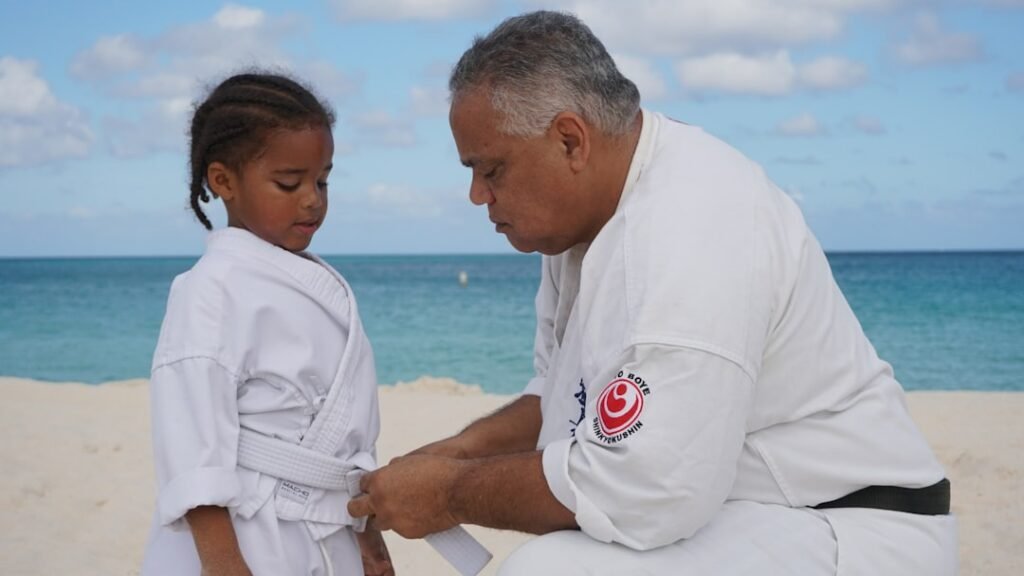
There’s a moment that happens in the dojang that I’ve watched repeat itself more times than I can count — with my own sons, with their classmates, with kids who walk in nervous on their first day and walk out a year later standing taller than their parents ever imagined. It’s the moment right before a board break, or a belt test, or a sparring match. The room gets quiet. Every eye is on one child. And that child has to reach down deep and choose to move forward anyway.
That moment — that specific, beautiful, terrifying moment — is one of the greatest gifts Tang Soo Do gives our kids. It’s not about the kick or the form or even the belt. It’s about learning to function under pressure. And in a world that asks our children to perform, compete, present, and produce at every turn, that skill is nothing short of essential.
As a mom who trains alongside her boys, I’ve seen this play out in real life in ways that still move me. My 15-year-old carries himself differently in school situations that used to rattle him. My 10-year-old, who once froze during a class presentation, now raises his hand first. None of that happened by accident. It happened because Tang Soo Do put them in high-pressure situations repeatedly — and gave them the tools to rise.
Why Pressure Is Good — When It’s the Right Kind
We live in a culture that’s increasingly uncomfortable with discomfort. We want to shield our kids from struggle, from failure, from anything that might sting. And I understand that impulse deeply — I’m a mom, after all. But there’s a critical difference between harmful stress and productive pressure, and Tang Soo Do lives in that second category.
Productive pressure is structured. It has a clear goal, a supportive environment, and a mentor guiding the process. It’s the kind of pressure that builds rather than breaks. When a child is asked to perform a hyung (form) in front of the class, the stakes feel real — but so does the safety net. Their instructor knows them. Their classmates are rooting for them. And the expectations are clear because they’ve been training toward this exact moment.
The World Tang Soo Do Association emphasizes character development as a foundational pillar of the art — not just physical technique. That philosophy shows up in how classes are structured, how students are challenged, and how failure is treated not as an endpoint but as part of the path.
The Dojang as a Practice Space for Real Life
Think of the dojang as a controlled environment where kids can rehearse being brave. Every class offers small pressure moments layered on top of each other over months and years. Reciting the student creed out loud. Answering the instructor’s question in front of the group. Demonstrating a technique while everyone watches. Sparring a partner who’s faster or stronger. Testing in front of a panel of black belts.
Each of those moments is a repetition — not just of a physical skill, but of a mental and emotional skill. The skill of steadying your breathing. The skill of focusing your mind when noise and nerves are competing for your attention. The skill of committing to action even when the outcome is uncertain.
My 12-year-old went through a stretch last year where belt testing genuinely terrified him. His technique was solid — his instructor said so. But the pressure of the test itself was causing him to lock up. We talked about it a lot, and what I kept coming back to was this: the test isn’t trying to trick you. It’s asking you to show what you already know. That reframe — combined with what he was learning in class about mental focus — changed everything for him. He didn’t just pass that test. He walked out of it a different kid.
Specific Ways Tang Soo Do Builds Pressure Tolerance
- Belt testing: Regular, formal evaluations teach kids that performance under observation is something they can prepare for and succeed at — not something to fear.
- One-step sparring: The back-and-forth structure of prearranged sparring drills builds the ability to react under pressure without panic or overthinking.
- Forms performance (hyungs): Memorizing and executing a sequence of techniques — sometimes in front of a full class — trains both discipline and composure.
- Tournament competition: Even for kids who don’t love competing, tournaments offer an unmatched pressure experience in a completely safe and supervised setting.
- Breaking techniques: The moment before a board break is pure mental game. The physical mechanics are secondary to the commitment of the mind.
If you’re curious about how tournament experience specifically shapes a child’s mindset, our post on tournament preparation for kids goes deeper into how to help your child walk into competition feeling ready rather than rattled.
What This Looks Like at Different Ages
One thing I love about training as a family is watching how the same principles land differently depending on where each of my boys is developmentally. For my 6-year-old, pressure tolerance right now looks like staying focused during a full class when he’d rather be doing literally anything else. That’s real. That’s hard for a six-year-old. And every time he does it, he’s building something.
For my 10-year-old, it looks like sparring a kid who’s been training longer and choosing not to give up just because he’s outmatched in that moment. For my 12-year-old, it’s the mental chess of testing — preparation, execution, recovery when something goes wrong. And for my 15-year-old, it’s leading by example, knowing that younger students are watching and that how he handles pressure sets a tone for the whole class.
The beauty of Tang Soo Do is that it scales. It meets each child where they are and asks just enough of them to grow. That’s not accidental — it’s baked into the philosophy of the art itself.
The Faith Connection I Can’t Ignore
As a Christian mom, I think about pressure through a lens that goes beyond sports psychology. Scripture talks constantly about trials producing perseverance, and perseverance producing character. That’s not abstract theology to me — I see it happening on the mat every single week. When my boys push through a hard class, a failed attempt, a moment when quitting would be so much easier, they’re building something that no trophy or rank can fully measure.
There’s a kind of strength that only comes from being tested. Tang Soo Do doesn’t just build physical strength — it builds the inner kind. And I believe that inner strength, that settled confidence in one’s own ability to endure, is one of the most important things we can cultivate in our children.
How Parents Can Support This Process
If you’re a martial arts parent watching your child struggle with pressure moments, here’s what I’d encourage you to do — and what I wish someone had told me earlier in our journey:
- Don’t rescue too quickly. Let them sit in the discomfort just long enough to discover they can handle it.
- Debrief without judgment. After a tough class or test, ask open questions rather than jumping to fix-it mode.
- Celebrate the attempt, not just the outcome. The kid who stepped up to break the board and missed still did something brave. Name that.
- Train alongside them if you can. Nothing communicates “this is worth doing” like a parent who does it too.
- Trust the process and the instructor. A good Tang Soo Do school knows exactly how much pressure to apply and when to back off.
If you’re still in the stage of evaluating schools and want guidance on what to look for in a quality program, our guide on finding the right martial arts school in Connecticut can help you ask the right questions before you commit.
The Amateur Athletic Union’s martial arts program also offers a helpful framework for understanding how youth martial arts programs are evaluated at a national level — worth a look if you’re comparing options.
The Long Game
What Tang Soo Do is really doing — underneath all the kicks and forms and belt tests — is teaching your child to trust themselves under pressure. That trust doesn’t arrive all at once. It accumulates, rep by rep, class by class, year by year. And one day you’ll see it in a moment that has nothing to do with martial arts — a job interview, a hard conversation, a moment of moral courage — and you’ll remember that freezing cold dojang floor and the instructor calling your child’s name and your child stepping forward.
That’s the long game. And it is absolutely worth playing.
