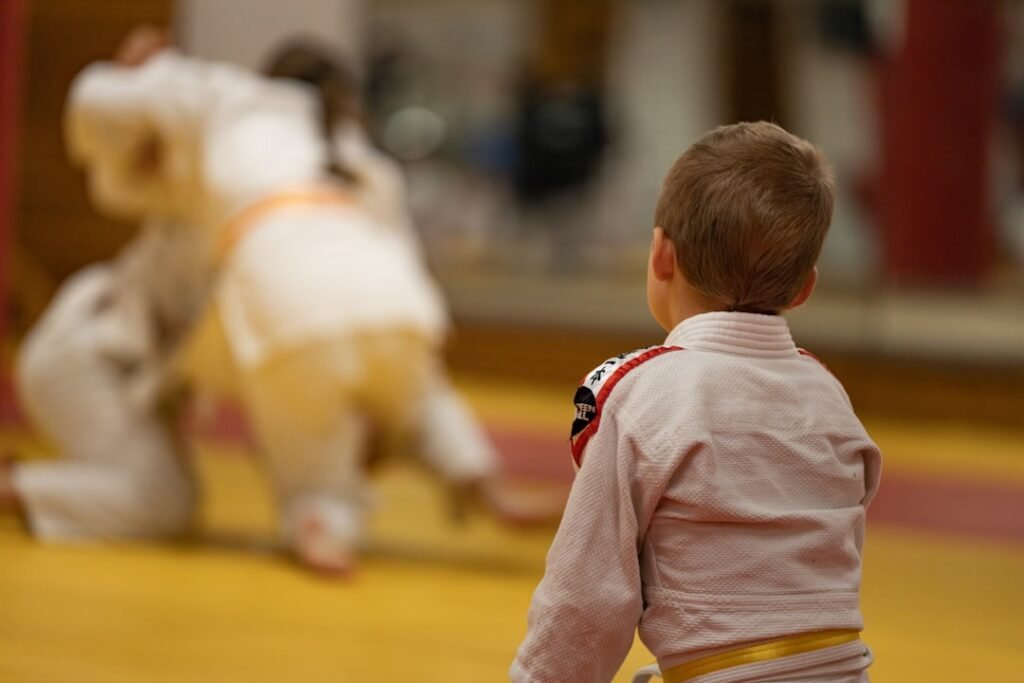
It started with a simple observation at our kitchen table. My 10-year-old sat down to do his homework one evening — no reminders, no drama, no staring at the ceiling for twenty minutes before putting pencil to paper. He just… started. And I remember thinking, when did this happen? The answer, when I traced it back honestly, was gradual. It happened on the dojang floor, one class at a time.
If you’re a parent on the fence about martial arts — maybe wondering whether the time commitment is worth it given everything else your kids have going on — I want to talk about something that doesn’t always make the front page of martial arts brochures: the direct, measurable connection between Tang Soo Do training and how kids perform academically. Because in our family, this connection has been anything but accidental.
What Happens in the Dojang That Changes the Brain
Tang Soo Do isn’t just physical exercise. Every class is a workout in sustained attention. From the moment a student bows and steps onto the floor, they are expected to listen carefully, retain sequences, and execute with precision. Our instructor doesn’t repeat himself three times. You pay attention, or you fall behind. That standard — delivered with respect and consistency — trains something in young minds that a classroom often struggles to replicate.
Neuroscientists have long documented the relationship between physical activity and cognitive function. Research from the CDC consistently shows that physical activity improves concentration, memory, and classroom behavior in school-age children. But what makes martial arts uniquely powerful isn’t just the movement — it’s the structured, disciplined nature of that movement. Learning a hyung (form) requires the same mental muscle as memorizing a history timeline or working through a multi-step math problem: sequencing, pattern recognition, and focused repetition.
My 12-year-old is a perfect example. He has always been bright, but distraction was his kryptonite. Sitting still, staying on task, circling back when he made an error — these were genuine struggles. After a year of consistent training, his teacher pulled me aside at a conference and asked what we’d changed at home. Nothing at home, I told her. But a whole lot had changed on the mat.
The Discipline Transfer Is Real
One of the things I love most about Tang Soo Do is that the standards don’t bend. When my 15-year-old is working toward his next rank, he knows exactly what is expected of him — and he knows that cutting corners in his practice will show up in his test. There’s no extra credit, no curve, no sympathy grade. You either know your material or you don’t. That kind of honest accountability is a gift.
What I’ve watched happen over time is what I’d call a discipline transfer. The habits trained in the dojang — showing up prepared, following through even when it’s hard, correcting mistakes without falling apart — begin to show up at the desk. My sons have learned, through thousands of repetitions, that effort over time produces results. That lesson doesn’t stay in the gym. It follows them to school, to church, to every area of their lives.
Proverbs 12:1 says, “Whoever loves discipline loves knowledge.” I think about that verse often when I’m watching my boys train. God didn’t design discipline as punishment — He designed it as a pathway. Tang Soo Do just happens to be one of the clearest, most tangible pathways we’ve found.
Goal-Setting Skills That Classroom Teachers Notice
Belt progression in Tang Soo Do is one of the most effective goal-setting frameworks I’ve ever seen for children. Each rank has specific requirements. Students know what they need to work on, how long they’ll likely be at a given level, and what success looks like. That clarity — and the experience of working steadily toward a defined goal — builds a mental model that carries over directly into academic life.
When my 6-year-old started setting small goals for himself at school — “I want to finish my reading before snack time” — I recognized the thinking pattern immediately. He’d learned it at belt rank. He understood, in his six-year-old way, that big things are made of small steps, and small steps require daily effort. Understanding how Tang Soo Do belt progression works isn’t just useful for martial arts parents — it’s a window into one of the most effective child development frameworks available.
The World Tang Soo Do Association emphasizes character development as a cornerstone of the art — not a side benefit. Respect, self-control, and perseverance aren’t just values posted on a dojang wall. They are trained, tested, and demonstrated. And those qualities are exactly what teachers describe when they talk about students who succeed academically.
Managing Stress and Emotional Regulation
Here’s something we don’t talk about enough: academic struggles are often emotional before they are intellectual. A child who melts down when a problem is hard, who shuts down under test pressure, or who gives up the moment confusion hits — that child isn’t lacking intelligence. They’re lacking the emotional regulation tools to push through discomfort.
Tang Soo Do teaches this beautifully and consistently. Every class presents moments of difficulty — a technique that won’t click, a sparring partner who’s faster, a form that has to be repeated until it’s right. Students learn to breathe through frustration, to reset and try again, and to receive correction without crumbling. These are not soft skills. These are critical life skills, and they translate directly to test-taking, project work, and the inevitable hard days every student faces.
My 10-year-old used to cry when he got a wrong answer on a math test. Not because he was overly sensitive — but because he had no framework for responding to failure productively. Training changed that. Now he approaches a hard problem the same way he approaches a technique he hasn’t mastered yet: with patience, repetition, and the firm belief that he can figure it out if he keeps working.
What Connecticut Families Should Know
If you’re raising kids in Connecticut — whether in the suburbs, a small town, or a more urban area — you know that academic pressure starts early and builds fast. From standardized testing to competitive extracurriculars, children today carry real cognitive and emotional loads. What they need alongside that pressure is not more instruction. What they need is training in how to handle the pressure itself.
That’s exactly what a well-run Tang Soo Do program provides. And unlike some high-pressure activities that add stress to a child’s week, martial arts tends to regulate and reset. My boys come home from class calmer, more focused, and more ready to sit down and do the work that needs to be done. It’s one of the most consistently observable patterns in our household, and talking to other martial arts families in our area, I hear the same thing over and over.
If you’re also thinking about how martial arts fits into your child’s overall development — academically, socially, and spiritually — it’s worth exploring the broader benefits of martial arts for children at different developmental stages. The academic connection is just one piece of a much richer picture.
The Long View
I want to be honest: Tang Soo Do doesn’t turn a struggling student into an honor roll student overnight. What it does — quietly, persistently, and deeply — is build the inner qualities that make academic growth possible. Focus. Perseverance. Emotional steadiness. Respect for process. The willingness to try again.
These are qualities that no tutoring session or enrichment program can install from the outside. They have to be trained from the inside out. And that is exactly what this art does, class by class, year by year, in every child who steps onto the mat with an open heart and a willingness to work.
For our family, Tang Soo Do isn’t a backup plan or a fun activity to fill Tuesday nights. It’s a core part of how we’re raising four boys to be capable, grounded, and resilient — in school, in life, and in faith. Watching the classroom results follow the dojang results has been one of the most encouraging confirmations that we’re on the right path.
If you’re a Connecticut family wondering whether this investment is worth it — I’m here to tell you it absolutely is. Not just for the kicks and forms. For everything that comes with them.
