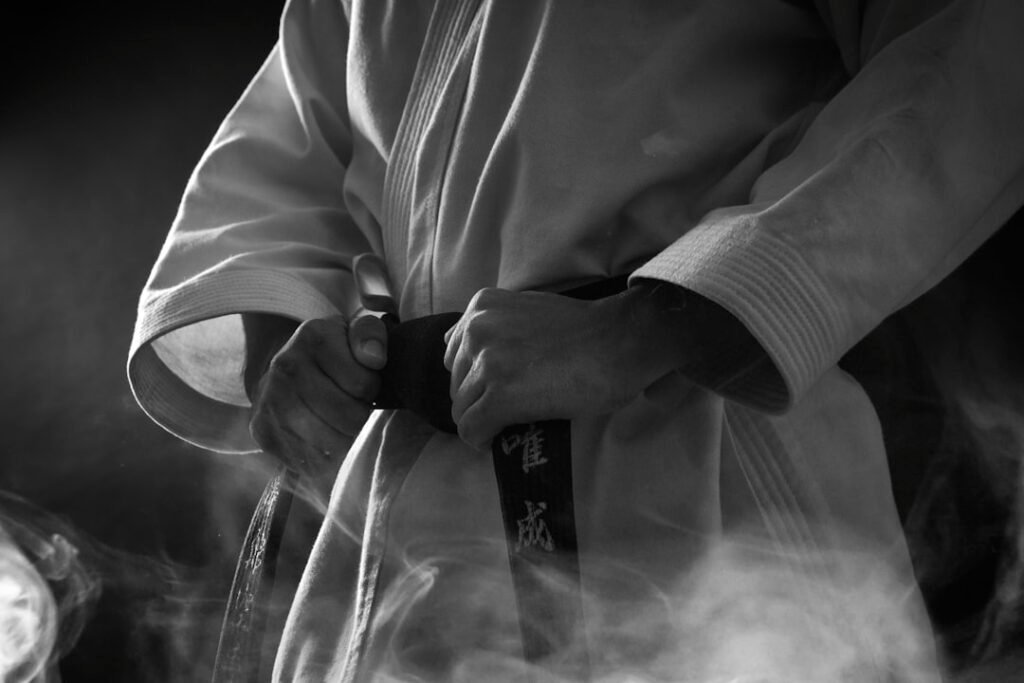
My 12-year-old had a baseball game last spring that I keep coming back to. Bottom of the last inning, two outs, his team down by one. The pitcher wound up, threw a fastball, and my son — who had been striking out more than he’d like that season — took a breath, planted his feet, and cracked that ball into the outfield. They lost anyway, but the coach pulled me aside afterward and said, “I don’t know what changed with him, but his composure at the plate is completely different.” I knew exactly what changed. He’d just passed his intermediate belt test three weeks earlier, and the mental training he’d gone through to get there had quietly reshaped the way he handles pressure.
That conversation stuck with me, and it’s one I’ve had versions of with other parents at our dojang here in Connecticut. Moms and dads whose kids play soccer, swim competitively, run track, play football — all noticing something different in their children after months or years of Tang Soo Do training. It’s not a coincidence. The skills built on the mat have a way of bleeding into everything else a child does, athletically and otherwise.
The Physical Foundation Tang Soo Do Builds
Let’s start with the body, because the physical benefits are real and measurable. Tang Soo Do training develops a specific combination of qualities that most youth sports coaches dream about seeing in their athletes. We’re talking about balance, coordination, flexibility, core strength, and body awareness — all developed through consistent, progressive training.
My 10-year-old started swimming competitively around the same time he began Tang Soo Do. His swim coach has mentioned more than once that his kick strength and core stability are exceptional for his age group. That’s not from the pool. That comes from hundreds of repetitions of front kicks, side kicks, and spinning back kicks — exercises that build exactly the hip flexor strength and rotational core power that swimmers depend on. He doesn’t think of it that way, of course. He just knows he likes kicking things and he likes going fast in the water. But the connection is there.
The flexibility training woven into every Tang Soo Do class is another huge advantage. We stretch every single session — not just a quick warm-up, but dedicated stretching that builds real range of motion over time. Young athletes who have that flexibility are less prone to injury, recover faster, and move with a fluidity that shows up in every sport they play. For a 6-year-old just developing motor skills, that foundational movement training creates athletic patterns that will serve them for decades.
Discipline and Focus — The Hidden Edge
Here’s what I’ve come to believe after years of training alongside my boys: the mental skills are actually the bigger gift. The physical benefits are impressive. But the discipline and focus that Tang Soo Do demands — and develops — are what make kids genuinely better performers across the board.
In our dojang, we don’t just practice techniques. We practice attention. When Grandmaster or your instructor is demonstrating something, you watch. You don’t fidget, you don’t chat, you don’t half-pay-attention. You watch and you absorb. That habit of focused attention is one of the most valuable things a young person can develop, and it’s one that most schools and sports programs struggle to teach intentionally.
My 15-year-old plays basketball, and his coach told me early in the season that he’s one of the few players on the team who can actually receive coaching mid-game without getting defensive or distracted. He hears the correction, adjusts, and moves on. That’s a direct product of years of receiving feedback from his Tang Soo Do instructors — learning that correction isn’t criticism, it’s instruction. That’s a mindset shift that takes most athletes years to develop. He’s had it since he was nine.
For families considering martial arts alongside other activities, this is worth understanding deeply. Tang Soo Do doesn’t just make your child a better martial artist. It trains the mind that shows up to every practice, every game, every classroom. Building discipline and focus through Tang Soo Do is something we talk about a lot on this blog — and its reach extends far beyond the dojang walls.
Handling Pressure and Performing Under Stress
Youth sports are full of high-pressure moments. The penalty kick. The free throw with two seconds left. The relay handoff. These moments reveal what a young athlete is made of — and they can be genuinely scary for kids who haven’t been taught how to manage their nerves.
Tang Soo Do is, at its core, a discipline built around performing under pressure. Every belt test is a performance evaluation. Every sparring round asks you to think clearly while someone is actively trying to score on you. Every time you step up to demonstrate a form (hyung) in front of your class, your instructors, and sometimes a panel of higher-ranking judges, you are practicing exactly the mental skill of composure under observation.
The breathing techniques we practice, the mental preparation before testing, the ability to reset after a mistake and keep going — these are tools that transfer directly to athletic competition. The USA Tang Soo Do Federation has long recognized that the mental discipline of traditional martial arts is inseparable from physical performance, and that’s exactly what we see lived out on fields and courts across Connecticut every weekend.
I’ve watched my boys handle tough sports moments differently than many of their teammates — not because they’re better athletes, but because they’ve been through harder mental tests on the mat and learned to keep their heads. That’s a gift I’m grateful we’ve been able to give them.
Respect, Coachability, and Team Dynamics
Every single class at our dojang begins and ends with a bow. We bow to our instructors, we bow to our training partners, we bow to the mat itself. That might seem ceremonial to an outsider, but it is forming something in these children. It is building a posture of respect — toward authority, toward peers, toward the process of learning.
Coaches notice this in martial arts kids. They’re more coachable. They say “yes sir” or “yes ma’am” without rolling their eyes. They line up when asked. They help younger teammates without being asked. These aren’t small things. In a team environment, a kid with a spirit of respect and service lifts everyone around them.
As a Christian mom, this is one of the places where Tang Soo Do and our faith run most naturally together. The Bible calls us to “do nothing from selfish ambition or conceit, but in humility count others more significant than yourselves” (Philippians 2:3). That’s not just theology for Sunday morning — that’s the spirit we’re trying to build in our sons every day, in every arena of their lives. The dojang gives us a structured, consistent place to practice it.
A Note for Connecticut Families Juggling Multiple Activities
I hear from a lot of families who wonder whether martial arts is worth adding to an already full schedule of sports, school, and activities. My honest answer is that Tang Soo Do has a multiplying effect on everything else your child is doing. It doesn’t compete with your child’s soccer season or swim team — it quietly makes them better at both.
The Amateur Athletic Union has supported youth martial arts programs for decades precisely because the foundational skills translate across athletic disciplines. Connecticut families have access to strong Tang Soo Do programs, and the investment of two or three classes per week pays dividends in every other area of your child’s athletic and personal development.
If your child is already in a sport and you’re wondering whether to add martial arts, here’s what I’d encourage you to look for after a few months of training: notice their composure at difficult moments, their response to correction, their ability to focus under pressure, and the way they carry themselves around coaches and teammates. Those changes — quiet, steady, and real — are the ones that last a lifetime.
We didn’t start Tang Soo Do looking for a competitive athletic edge. We started because we wanted to train together as a family and build something in our boys that went deeper than trophies. But we found the edge anyway — and it shows up every time one of my sons steps onto a field, a court, or a stage and handles himself with exactly the kind of strength and steadiness we’ve been praying for all along.
