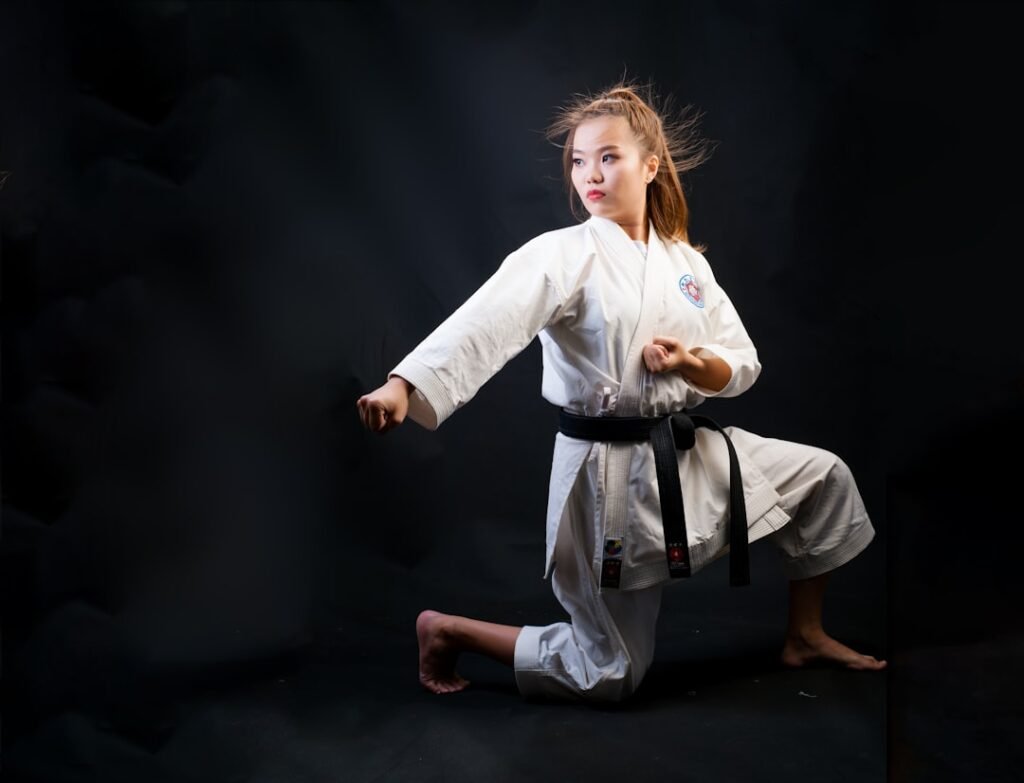
There’s a moment that happens in the dojang that I don’t think you can manufacture anywhere else. It’s the moment a child who once shuffled through the door with slumped shoulders and wandering eyes stands at attention — feet together, chin up, eyes forward — and means it. Not because someone told them to look confident. Because somewhere along the way, they became it. I’ve watched it happen with all four of my boys, and every single time, it stops me in my tracks.
Tang Soo Do is often described as a traditional Korean martial art that emphasizes striking techniques, forms, and self-defense. All of that is true. But if you ask me — a mom who trains alongside her sons and has spent years watching this art shape young people from the inside out — Tang Soo Do is really a system for developing the whole child. Physically. Mentally. Morally. And for families here in Connecticut who are weighing whether martial arts is worth the commitment, I want to walk you through exactly what that development looks like in practice.
Physical Development: More Than Kicks and Punches
Let’s start with the obvious: Tang Soo Do builds strong, capable bodies. But the physical benefits go much deeper than the surface-level fitness you might expect. When my 6-year-old first started training, his biggest physical challenges were balance and coordination. Within just a few months, I could see his body awareness changing. He stopped tripping over his own feet. He started moving with intention.
For younger children, martial arts training develops what exercise scientists call fundamental movement skills — balance, coordination, agility, and spatial awareness. These foundational abilities don’t just make kids better martial artists. They make them better athletes across every sport and activity they participate in.
For older kids and teens, the physical development shifts. My 15-year-old trains with a level of athletic intensity that rivals any sport he’s played. Tang Soo Do demands explosive power, flexibility, cardiovascular endurance, and muscle control — often all within a single class. The forms, or hyungs, require full-body engagement and precision. Sparring demands quick-twitch athleticism and physical composure under pressure. And the self-defense applications build functional strength that carries over into real life.
One thing I appreciate about Tang Soo Do specifically is that it doesn’t favor one body type. My boys are all built differently, and each of them has found ways to excel through their own physical strengths. The art meets them where they are and challenges them to grow from there.
Mental Development: Focus, Discipline, and the Ability to Persist
If I had to choose one word to describe what Tang Soo Do does for a child’s mind, it would be focus. And I say that as a mom of four boys who have, at various times, struggled with staying on task, following through, and managing frustration.
Every class in the dojang is a structured exercise in mental discipline. Students must listen carefully, remember combinations and sequences, respond to Korean commands, and control their bodies — all at the same time. For younger children, this kind of multi-layered attention-building is genuinely challenging. For my 10-year-old, who can be easily distracted in other settings, I’ve noticed that his ability to concentrate has sharpened significantly since he began training. His teacher has noticed it too.
The mental benefits extend well beyond focus. Goal-setting is baked into the fabric of Tang Soo Do. Every belt test is a milestone. Every new form is a challenge to conquer. Every sparring match is an opportunity to apply what’s been learned under real pressure. Children who train learn to break big goals into smaller steps — a skill that serves them in school, in relationships, and in life.
Perseverance is perhaps the most powerful mental quality that martial arts builds. There will be forms that take months to perfect. There will be techniques that feel impossibly awkward at first. There will be belt tests that don’t go the way a child hoped. Learning to sit with frustration and keep training anyway is one of the most valuable lessons the dojang teaches — and it’s one that I’ve seen my sons carry into every other area of their lives.
Moral Development: Respect, Humility, and Character
This is the part of Tang Soo Do that matters most to me as a mom and as a Christian. Physical fitness is wonderful. Mental sharpness is valuable. But what I ultimately want for my boys is for them to grow into men of strong character — men who are humble, respectful, self-controlled, and grounded in something deeper than their own ambitions.
Tang Soo Do has a built-in moral framework. The World Tang Soo Do Association upholds a code of conduct rooted in values like loyalty, respect, obedience, and self-control — principles that align naturally with what we teach at home and in our faith. The dojang reinforces these values in a concrete, repeated way that children can actually internalize.
From day one, students learn to bow when entering the dojang, to address instructors with respect, to encourage their training partners, and to exercise self-control even when they’re tired or frustrated. These aren’t abstract lessons written on a poster. They’re practiced behaviors, repeated hundreds of times, until they become habit. And habits, as any parent knows, are the building blocks of character.
My 12-year-old has become someone his younger brothers look up to — not because of his rank, but because of how he carries himself. He’s patient with his 6-year-old brother on the mat. He’s respectful to instructors even when he disagrees. He’s learning what it means to lead by example rather than by force. I credit a lot of that to the moral culture of Tang Soo Do.
For families of faith, there is something particularly meaningful about an art that treats humility as a strength. In our house, we talk often about how God honors those who serve others and hold themselves accountable. Tang Soo Do reinforces that message week after week on the mat.
How Development Looks Different at Different Ages
One of the things I love about Tang Soo Do is that it grows with a child. The way the art develops a 6-year-old is genuinely different from the way it develops a teenager — and a quality instructor will tailor expectations accordingly.
- Young children (ages 5–8): The focus is on listening skills, body awareness, basic coordination, and learning to follow instructions. Classes are energetic and game-like while still instilling structure and respect. The win at this age is simply showing up consistently and building a positive relationship with discipline.
- Middle childhood (ages 9–12): Children at this stage are capable of more technical precision and can begin to grasp the deeper meaning behind techniques and forms. They’re also navigating social dynamics, and the dojang becomes a place where they can build confidence and find their identity apart from peer pressure.
- Teenagers (ages 13–18): This is where Tang Soo Do can be transformative. Teens face enormous pressure — academic, social, and emotional. A consistent martial arts practice gives them an outlet, a community, a sense of achievement, and a framework for handling stress and adversity with grace rather than reactivity.
If you’re curious about how belt progression maps onto this developmental journey, our guide to Tang Soo Do belt ranks breaks down what each level means and what students are working toward at every stage.
What Connecticut Families Should Know Before Starting
If you’re a Connecticut family considering Tang Soo Do for your child — or your whole family — here’s my honest encouragement: start sooner rather than later, and commit to the journey rather than the destination. The development I’ve described doesn’t happen after one class or even one belt test. It happens over years of consistent practice, patient instruction, and genuine investment from parents who show up, pay attention, and affirm what their children are learning.
Look for a school that takes character development as seriously as technique. Ask instructors how they handle frustration, failure, and conflict in the dojang. Watch a class before enrolling. Notice how students treat each other, how instructors communicate with kids, and whether the culture feels like one you want your child immersed in.
And if you can, train alongside your child. I started training partly to understand what my boys were experiencing, and it became one of the most meaningful things our family does together. There’s something powerful about a child watching their parent struggle with a new form, keep going, and eventually get it right. It teaches more than words ever could.
Tang Soo Do won’t make your child perfect. It won’t eliminate meltdowns or homework battles or sibling arguments. But it will give them tools — physical, mental, and moral — that they will carry for the rest of their lives. And as a mom, that’s exactly what I’m building toward, one class at a time.
